FLEXURAL FATIGUE FAILURE ANALYSIS OF GLASS POLYESTER UNIDIRECTIONAL ANGLE PLY COMPOSITE LAMINATE

ijerstThis paper, published in « International Journal of Engineering Research and Science & Technology« , presents a study of the fatigue failure behavior of unidirectional angle ply composite laminate. Today a lot of research is directed to understand the fatigue failure behavior of laminated composites. These materials usage is increasing in all sorts of engineering applications due tohigh specific strength and stiffness, low weight and corrosion resistance. Fibre reinforced composite materials are selected for weight critical applications, due to good rating as per the fatigue failure is concerned and these materials are anisotropic in nature. The failure behavior made the study of these materials complicated………….

Read more

Etude de la défaillance d’un vilebrequin de moteur marin

A paper in « Engineering Failure Analysis » published on ScienceDirect.com about a  case study of a catastrophic failure of a web marine crankshaft and a failure analysis under bending and torsion applied to crankshafts are presented


touche Read more


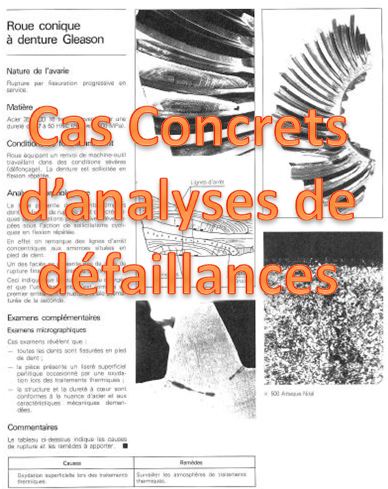
Comprendre et anticiper les défaillances de pièces mécaniques métalliques

Le Cetim est leader français en analyse de défaillances mécaniques, enrichi de son expérience de 40 ans, de 1000 nouveaux cas traités par an dans tous les domaines de la mécanique. En confiant votre expertise au Cetim, centre technique indépendant et neutre, vous êtes assuré d’une approche objective, compétente et factuelle.

Ses équipes dédiées pratiquent l’analyse des défaillance au quotidien et s’engagent sur des diagnostics.

telecharger le doc

Rupture de l’arbre de transmission du rotor de queue

Le 2 juillet 2007, un hélicoptère Bell 214B1 effectue des opérations d’hélidébardage depuis Ramsay Arm (C.-B.)L’hélicoptère descend à la verticale et heurte plusieurs arbres avant de se poser brutalement sur le relief accidenté. L’hélicoptère est lourdement endommagé à l’atterrissage, mais il n’y a pas d’incendie. L’enquête révélera une faiblesse structurale de la poutre de queue.

Acceder article

Airbus va accentuer l’inspection des poutres d’ailes de l’A380 – Capital.fr

Airbus a ordonné des inspections accrues sur les ailes de son très gros porteur A380 après avoir découvert des niveaux inattendus de fatigue du métal durant des tests en usine, a-t-on appris jeudi de sources industrielles.

Plus d’information.

Failure of a Motor Vessel’s Crankshaft 1968

An interesting paper published in  « Engineering Failure Analysis » :

In July 1968 the Swedish motor vessel “MV Stureholm” traveled from Sweden across the North Atlantic with destination to the American gulf harbours.  About 100 nautical miles north of the peninsula Yucatan the 9,000 HP diesel engine failed as a consequence of fatigue failure of the crankshaft. The ship was disabled and had to be towed to Veracruz, Mexico. The Swedish shipowning company decided to perform a temporary repair in Veracruz by welding the fatigue crack. Back in Sweden the damaged but repaired crankshaft was dismounted from the engine and inspected by surveyors. The result was that a fatigue crack had initiated from a subsurface solidification (hot) crack.

This paper brings out the detail of investigation carried out. Read more at : Failure of a Motor Vessel’s Crankshaft 1968.

Fracture analysis of wind turbine main shaft

Read on Engineering Failure Analysis. Shaft fracture at an early stage of operation is a common problem for a certain type of wind turbine. To determine the cause of shaft failure a series of experimental tests were conducted to evaluate the chemical composition and mechanical properties. The results show that stress concentration on the shaft surface close to the critical section of the shaft due to rubbing of the annular ring and coupled with high stress concentration caused by the change of inner diameter of the main shaft are the main reasons that result in fracture of the main shaft. The contribution of this paper is to provide a reference in fracture analysis of similar main shaft of wind turbines.

Service fatigue cracking in an aircraft bulkhead exposed to a corrosive environment


This paper presents a supporting case study that examines fatigue cracks that were detected in an F/A-18 Hornet bulkhead during post-service testing and teardown. The in-service phase of the cracking had significant evidence of oxidation on their surfaces which indicated an exposure to a mildly corrosive environment. Both the service and laboratory phases of the cracking were the subject of quantitative fractography and estimates of the crack growth rates were made. A comparison of the in-service and the in-test phases of crack growth indicated that no notable effect on the service part of the fatigue crack could be attributed to its exposure to the service environment.

Read the article on http://www.sciencedirect.com

Quatre nouveaux cas concrets de ruptures

Avatar Cas ConcretsUne série de ruptures différées d’un lot de vis M24 classe 12.9,  des fissurations par corrosion sur les coudes de l’économiseur d’une chaudière, des ruptures brutales sur des marteaux de déchiqueteuses et enfin la rupture par fissuration progressive d’une pâle de ventilateur .

Ces quatre fiches d’analyse de défaillances avaient été publiées en juin 1988 dans le numéro 106 de la revue Cetim-information, elles viennent d’être republiées, elles sont toujours d’actualité.

Lire plus.

Rolls Royce admet un défaut de qualité dans un moteur de A 380

Des fissures dans un tuyau d’alimentation en huile ont causé une  explosion dans un moteur sur un A380-900 de la Qantas en 2010.

Le Bureau de la sécurité des transports australien (ATSB) a publié son troisième et dernier rapport sur l’accident, après avoir constaté que les tuyaux d’alimentation en huile du moteur n° 2 de l’A380 n’était pas conforme aux spécifications de conception. L’ATSB a constaté que la panne moteur était le résultat d’une fissure de fatigue dans un tuyau d’alimentation en huile. Ce tuyau n’avait pas l’épaisseur de paroi requise.

Depuis l’incident, Rolls-Royce, les organismes de réglementation de l’aviation, et les opérateurs de A380 900 ont pris une série de mesures pour s’assurer que les moteurs avec tubulures d’alimentation en huile mal fabriquées ont été retirés du service ou fixés de manière que l’avion pourrait fonctionner en toute sécurité.