Failure analysis of a cracked aluminum 7075 wing internal angle in Airbus A-300

2016-07-05_16h39_20


An article in progress in « Case Studies in Engineering Failure Analysis », Volume 7 (october 2016).


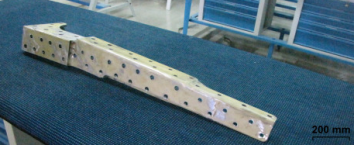
There are 16 angles in Airbus A300s wing box. On the right side, rear spur, and lower flange area of the center wing box, one of these angles had been cracked with a length of 28 mm. This crack has decreased residual strength of the part under allowed values and resulted to a rupture in the rear spur lower cap. Several reports of the same occurrences in other Airbus A300 air crafts, highlight the importance of finding the causes of this failure.  Finally, it was concluded that corrosion fatigue was the main reason which itself comes from manufacturing, maintenance, metallurgical, and geometric reasons as were discussed in this study.
Read more

Root cause analysis (RCA) of fractured ASTM A53 carbon steel pipe at oil & gas company

2016-07-05_16h25_54

An article in progress in « Case Studies in Engineering Failure Analysis », Volume 7 (october 2016).


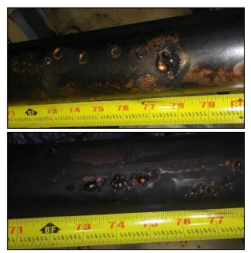
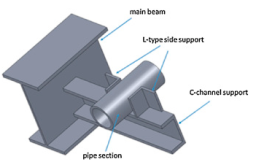
Incident involving failures of ASTM A53 carbon steel pipe, connected to pressure safety valve and carrying raw gas has caused serious supply disruption. This study was performed to identify the most probable cause of the pipe failure.

Read more

Stress corrosion cracking of full sized rockbolts

2016-06-04_07h48_16An article published in  « International Journal of Rock Mechanics & Mining Sciences – 81 (2016)« .

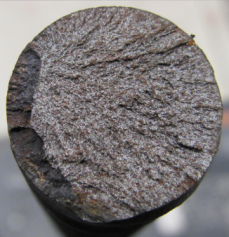
Previous studies had identified that a testing protocol was required to examine stress corrosion cracking (SCC) of full sized rockbolts under simulated in situ conditions. It was found that SSR testing provided an appropriate analogue for examining rockbolt susceptibility to SCC and was thus used to examine the effect of grit blasting, galvanising and varying steel grades on the SCC resilience of rockbolts. Of these, 300 grade steel and galvanising provided the most promising resistance to SSC, while grit blasting provided a 40% improvement in resistance compared to untreated HSAC 840 grade rockbolts.

More

Burst strength of glass fibre/epoxy composite pipes subjected to impact loading

An article discussed during the International Conference on Applications and Design in Mechanical Engineering 2015 (ICADME2015)

icadme2015

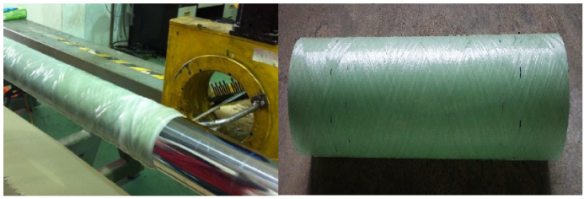
The main objective of this experimental study was to investigate the effects of low velocity impact loading on the pressure bearing capacity of the E-glass/epoxy composite pipes. The pipes were produced by the conventional filament winding technique comprises of six axisymmetric layers with (±55°)3 winding angles. The specimens were impacted at three different energy levels which are 5 J, 7.5 J, and 10 J using an instrumented drop weight impact testing machine (IMATEK IM10). The samples were then filled with water and subjected to burst test until distinct leakage failure is observed. The results indicate that the peak force and contact time increases with increased of impact energy. For impacted samples, the pressure tests show that the burst strength of the pipes decreases with increase in energy levels during impact loading. During the burst tests, several damage types named leakage and eruption were observed.

Read more

Failure investigations of a 900 KV bil trench cota bushing

A case study of failure discussed in the 82 nd International Conference of Doble Clients.

bushingThe discussion of this paper will focus on the H1 Trench COTA bushing, which failed after field maintenance handling that would not normally be expected to have a negative effect on a bushing. Following the failure, the top air side porcelain was found ruptured and missing; the bottom insulator was fractured into a number of pieces. The H2 and H3 bushings from this transformer, which were identical Trench type bushings, were also removed and disassembled for inspection to help identify a possible root cause of the H1 bushing failure.

More at : http://www.doble.com/content/show/boston2015/files/BIIT/BIIT-2_Trench_COTA_Failure_Root_Cause_Mani.pdf


Fatigue Failure of Aluminium Alloy Piston

An article published in International Research Journal of Engineering and Technology (IRJET), Volume: 03 Issue: 04 | Apr-2016.
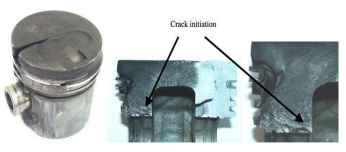
pistonAn analytical study was performed about piston failure by fatigue. Fatigue cracks are initiated and propagated by the action of mechanical and high temperature loading conditions which induces cyclic stresses in the piston material.  Various proposals and solutions are presented so that necessary care can be taken to prevent piston failure in future.

Read more

Catastrophic failure of a carbon steel storage tank due to internal corrosion

A case study of failure analysis published in « Case Studies in Engineering Failure Analysis« , october 2013.

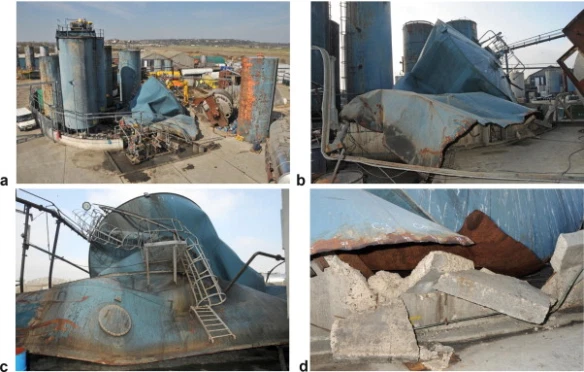
Catastrophic failure of a 10 m high, 8 m diameter steel storage tank containing approximately 350 m3 of waste solvent led to a significant environmental incident in 2009. An investigation was carried out to establish the root cause and to learn lessons that might prevent a reoccurrence.

Read more

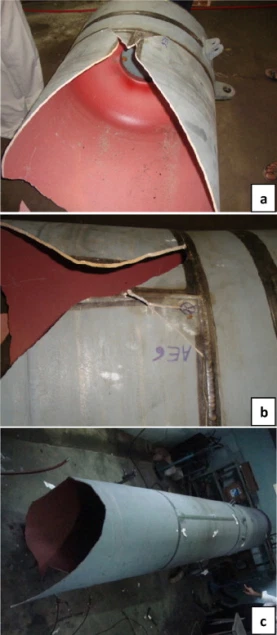
Failure analysis of a high strength low alloy steel pressure vessel


A Failure Analysis published in « Case Studies in Engineering Failure Analysis » october 2013.

High strength low alloy (HSLA) steel with a nominal composition of 0.15C–1.25Cr–1Mo–0.25V is being extensively used in space programme. Owing to its ease of fabrication and welding, a tank was fabricated out of this alloy. The tank is used to contain strontium per chlorate which on combustion develop secondary thrust, effectively used during attitude control of satellite launch vehicle. During one of the routine qualification tests, a tank had failed at an internal pressure of 109 bar, against a designed proof pressure of 120 bar.

Failure was initiated from long seam weld of a cylindrical shell and propagated into the parent material thereafter. Detailed metallurgical investigation has been carried out to understand the cause of failure. This paper brings out the detail of investigation carried out.

Read more

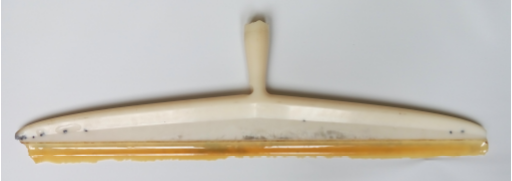
The Failure Analysis and Simulation of an ABS Extrusion Die

2016-04-18_23h25_24A paper published in « Procedia Engineering » and available on ScienceDirect.

Coat-hanger dies are widely used in the extrusion of plate and sheet, since it can achieve uniform velocity attribution on the outlet according to balancing the distribution of flow through the die. A failure ABS extrusion die of a petrochemical company is studied in this paper. The results show that the pressure drop in the die exceed the maximum allowable value, which is the main cause of die failure, in addition to the exceeded pressure drop the fluctuation of the velocity on the outlet is too large, which would lead to poor quality of product. The work in the paper provides guidance for the future die design and optimization.

Read the paper

Effect of Heat Treatments on Fatigue Failure and Fracture Toughness of Various Tool Steels

IJCETA paper published in « International Journal of Current Engineering and Technology » and available on International Press Corporation.

This paper present the state of the art review on the effect of the various heat treatments on fatigue strength and fracture toughness of the different tool steels. The different researchers used the experimental tests like thermal fatigue test, thermo-mechanical fatigue (TMF) test for calculation of fatigue strength and threepoint bend tests for fracture toughness of the tool steels.

Read the paper