L’émission acoustique pour vérifier l’étanchéité

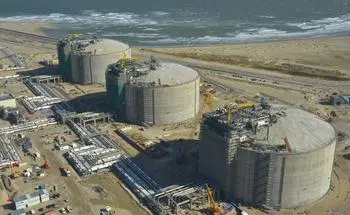
Entrepose-Contracting_Img_DetailReferencePour s’assurer de l’étanchéité des réservoirs de GNL du terminal méthanier de Dunkerque, la société Entrepose Contracting a choisi de procéder à un contrôle par émission acoustique


 La méthode de contrôle par émission acoustique mise en œuvre par le Cetim a permis de  répondre à aux interrogations d’Entrepose Contracting dans un délai extrêmement court. Les tests ont été exécutés sur trois jours dans des conditions d’accès et climatiques difficiles.  Soixante capteurs piézoélectriques positionnés tous les 5 m sur la périphérie du liner ont permis de localiser une zone problématique de faible dimension à la jonction d’un piquage d’une tubulure et du liner. À l’issue de l’investigation, la source du phénomène de bullage a été identifiée.

Lire l’article


Source : Entrepose Contracting – Cetim – Centre technique des industries mécaniques
Failure Analysis and Recovery of a 50-mm Highly Elastic Intermetallic NiTi Ball Bearing for an ISS Application

2016-09-21_21h33_08Read the full text of an article reported on NASA Technical Reports Server

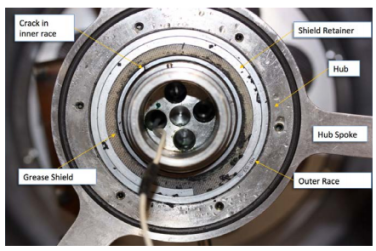
Ball bearings used inside the ISS Distillation Assembly centrifuge require superior corrosion and shock resistance to withstand acidic wastewater exposure and heavy spacecraft launch related loads. These requirements challenge conventional steel bearings and provide an ideal pathfinder application for 50-mm bore, deep-groove ball bearings made from the corrosion immune and highly elastic intermetallic material 60NiTi. During early ground testing in 2014 one 60NiTi bearing unexpectedly and catastrophically failed after operating for only 200 hr. A second bearing running on the same shaft was completely unaffected. An investigation into the root cause of the failure determined that an excessively tight press fit of the bearing outer race coupled with NiTi’s relatively low elastic modulus were key contributing factors. The proposed failure mode was successfully replicated by experiment. To further corroborate the root cause theory, a successful bearing life test using improved installation practices (selective fitting) was conducted. The results show that NiTi bearings are suitable for space applications provided that care is taken to accommodate their unique material characteristics.

Read more

Effect analysis of an arc-strike-induced defect on the failure of a post-tensioned threadbar

2016-09-06_15h41_49

An article about a case study published in « Case Studies in Engineering Failure Analysis » – april 2016.

A temporary threadbar used for precast segmental construction broke during the post-tensioning stage before reaching the service load. Failure analysis showed that the premature failure of the bar was due to the presence of an arc strike. The arc strike effects on the material and threadbar integrity are considered.

Read more

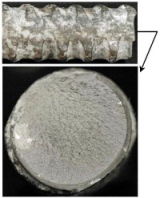
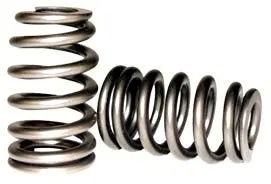
Effect of Hydrogen Charging on the Wear Behavior of Spring Steel

spring-steel-wireAn article published in the « International Journal of Engineering Science and Computing« , June 2016.

Spring steel is a prominent piece of material in industrial and automotive application. Hydrogen embrittlement (HE) is an inherent phenomenon, which will occur during the course of service life, at the same time it has to sustain a variety of loads acting on it. Among all the wear of spring steel plays a vital role. Hydrogen embrittlement leads for pre mature failure of the component. In view of this, an attempt was made in this experimental study to performance of hydrogen embrittled spring steel (EN-47 / SAE 6150/SUS 10) under the dry sliding condition. The specimen preparation and the experimentations have been carried out according to the ASTM standards. The experiments performed based on plan of taguchi technique. Cathodic charging is having been adopted for the embrittlement of the spring steel material. A known level of embrittlement has made, wear test has been carried out. Results have shown that, load and sliding distance is more pronounced on the wear of the embrittled spring steel material rather than speed.

Read more

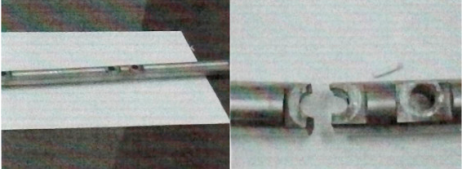
Analysis of a failed rocker arm shaft of a passenger car engine

2016-09-06_14h16_17

A case study published in « Case Studies in Engineering Failure Analysis » – april 2016.

This paper investigates the failure of a rocker arm shaft of a passenger car. The shaft failed by brittle fracture across one of the four holes supporting the shaft into the cylinder head. The running distance of the engine just before failure was 40,626 km. These cracks may have been induced in the shaft by the non-uniform cooling during quenching in the course of heat treatment, or may be nucleated by repeated loading during service. This premature failure has occurred by the rapid crack propagation because of the lower fracture toughness of the martensite.

Read more

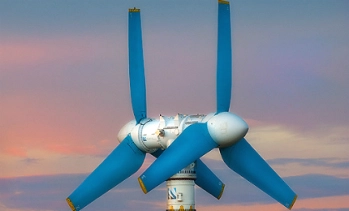
Wet Flexural Fatigue Behaviour of Tidal Turbine Blade Composite Materials

AK1000_Body_430A paper find on the web about fatigue of Tidal Turbine Blade Composite Materials.

This has led to the emergence of tidal turbine designs often inspired from earlier developments in the wind turbine industry.  Composite materials including Glass fibre reinforced polymers (GFRP) are a low-cost, low weight and corrosion resistant material for this application. Cyclic loading due to tidal flow and wave conditions is a common characteristic of tidal turbine devices and the good fatigue performance of composite materials means they are widely used, however limited information are available to predict material behaviour under coupled environmental and cyclic loading. This problem is addressed in this paper, by introducing a methodology for prediction of the fatigue behaviour of composite tidal turbine blades.

Read more


Hydrogen Embrittlement of Industrial Components: Prediction, Prevention, and Models

2016-07-05_17h26_56

A paper find on ResearchGate and published in « Corrosion-Houston_Texas « – July 2016.

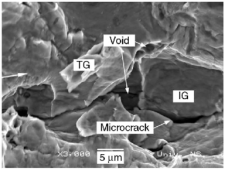
This paper gives an overview of the application of a model for structural integrity analysis of boiler tubes made of plain carbon steel exposed during operation to a local corrosion process and multiple hydrogen assisted degradation processes: hydrogen embrittlement and high-temperature hydrogen attack. The model is based on the correlation of mechanical properties to scanning electron microscopy fractography analysis of fracture surfaces in the presence of simultaneously active hydrogen embrittlement micro-mechanisms. The proposed model is practical for use as a predictive maintenance in power plants, as it is based on the use of standard macro-mechanical tests.

Read more

Failure analysis of tube-to-tubesheet welded joints in a shell-tube heat exchanger


An article in progress in « Case Studies in Engineering Failure Analysis », Volume 7 (october 2016).

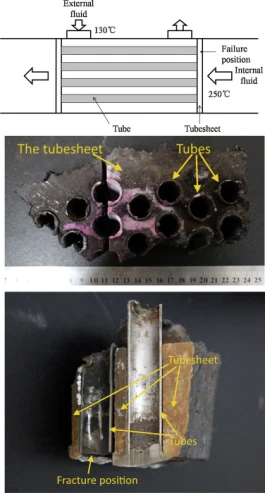
In this work, fracture failure of a shell-tube heat exchanger at the tube-to-tubesheet welded joints was investigated. Fatigue started at initial defects of the welded joint was confirmed as the failure mechanism of the heat exchanger. Bad welding and unsuitable expansion gave rise to the formation of initial cracks. The alternating stress comes from various reasons such as the resonant vibration.

Read more

Failure analysis of a diesel generator connecting rod

2016-07-05_16h55_33

An article in progress in « Case Studies in Engineering Failure Analysis », Volume 7 (october 2016).


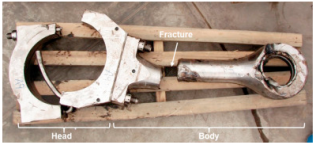
This paper presents the results of a failure analysis investigation conducted in a connecting rod from a diesel engine (18 V, four-stroke) used in the generation of electrical energy. The continuous output of the engine was 10.5 MW, at 600 rpm ; before the failure of the con-rod it accumulated 35836 service hours, working with a load factor of 80%.

Read more

Failure analysis of a half-shaft of a formula SAE racing car

2016-07-05_16h47_58An article in progress in « Case Studies in Engineering Failure Analysis », Volume 7 (october 2016).

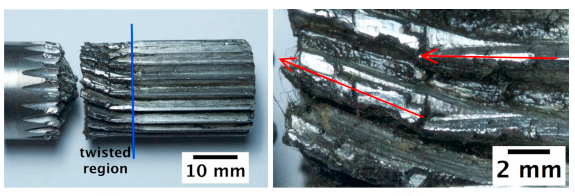
The formula SAE is a competition among students worldwide, where they are challenged to design, build and test a small formula-type racing car, following rules and specifications defined by the Society of Automotive Engineers (SAE). In the present analysis, a premature failure of a half-shaft of the transmission system of a racing car occurred after circa 100 km of use. The results show that the alloy steel bar used for the half-shaft did not follow specifications, with a consequent lower strength and resulting in a material with insufficient loading capacity and fatigue resistance. As a consequence, the fracture process was a confluence of torsional fatigue crack propagation and overload ductile fracture through the spline section of the half-shaft.

Read more