Sulfide stress corrosion cracking and hydrogen induced cracking

1-s2-0-s2213290213000424-gr11-s2-0-s2213290213000424-gr2

A case study published in « Case Studies in Engineering Failure Analysis » on www.sciencedirect.com.

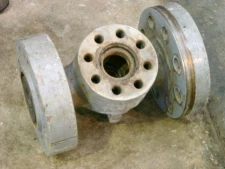
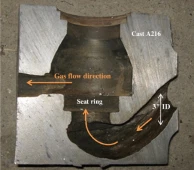
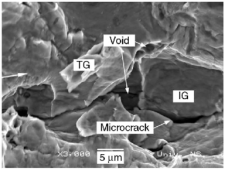
The wellhead flow control valve bodies which are the focal point of this failure case study were installed in some of the upstream facilities of Khangiran’s sour gas wells. These valve bodies have been operating satisfactorily for 3 years in wet H2S environment before some pits and cracks were detected in all of them during the periodical technical inspections. During investigation many cracks were observed on the inner surface of the valve body grown from the surface pits. The results indicate that flow control valve body failed due to combination of hydrogen induced corrosion cracking (HICC) and sulfide stress corrosion cracking (SSCC). According to HIC and SSC laboratory tests and also with regard to cost of engineering materials, it was evident that the best alternative for the valve body alloy is A217-WC9 cast Cr–Mo steel.
Read more

Effect of Hydrogen Charging on the Wear Behavior of Spring Steel

spring-steel-wireAn article published in the « International Journal of Engineering Science and Computing« , June 2016.

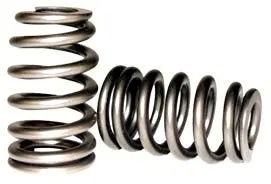
Spring steel is a prominent piece of material in industrial and automotive application. Hydrogen embrittlement (HE) is an inherent phenomenon, which will occur during the course of service life, at the same time it has to sustain a variety of loads acting on it. Among all the wear of spring steel plays a vital role. Hydrogen embrittlement leads for pre mature failure of the component. In view of this, an attempt was made in this experimental study to performance of hydrogen embrittled spring steel (EN-47 / SAE 6150/SUS 10) under the dry sliding condition. The specimen preparation and the experimentations have been carried out according to the ASTM standards. The experiments performed based on plan of taguchi technique. Cathodic charging is having been adopted for the embrittlement of the spring steel material. A known level of embrittlement has made, wear test has been carried out. Results have shown that, load and sliding distance is more pronounced on the wear of the embrittled spring steel material rather than speed.

Read more

Hydrogen Embrittlement of Industrial Components: Prediction, Prevention, and Models

2016-07-05_17h26_56

A paper find on ResearchGate and published in « Corrosion-Houston_Texas « – July 2016.

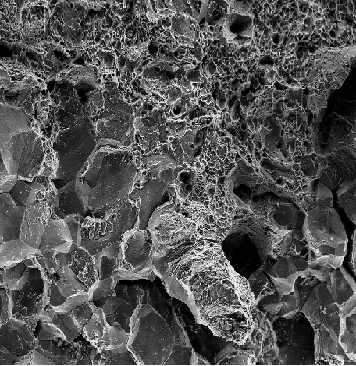
This paper gives an overview of the application of a model for structural integrity analysis of boiler tubes made of plain carbon steel exposed during operation to a local corrosion process and multiple hydrogen assisted degradation processes: hydrogen embrittlement and high-temperature hydrogen attack. The model is based on the correlation of mechanical properties to scanning electron microscopy fractography analysis of fracture surfaces in the presence of simultaneously active hydrogen embrittlement micro-mechanisms. The proposed model is practical for use as a predictive maintenance in power plants, as it is based on the use of standard macro-mechanical tests.

Read more

Hydrogen embrittlement in steel fasteners

hydrogen embrittlementThis paper is published on http://www.boltcouncil.org by Salim Brahimi, President at IBECA Technologies Corp, Chairman, Committee F16 (Fasteners) at ASTM International, The objective of this paper is to distil the latest knowledge related to hydrogen embrittlement into know-how in a manner that is complete yet simple, and directly applicable to fasteners. The topic is divided into basic components. First is a description of the theory and mechanism of hydrogen damage, followed by a discussion of conditions that are necessary for hydrogen embrittlement failure to occur. The fundamentals are followed by a description of HE test methods, guidelines for processing, surface cleaning, coating (particularly electroplating), and baking.

telecharger le doc

Defects and long term crack growth in rolled bars

Thesis WorkA Thesis work of  Högskolan Dalarna, Falun, Sweden online on http://www.diva-portal.org/.

This work has had the purpose to examine defects and the cause of crack growth during long termstorage in rolled bars. The bars in question are rolled and stored at Ovako in Hofors. The problem is approached by theoretically examining the possibilities of hydrogen damage, room temperature creep and naturally occurring porosity.

telecharger le doc

Stress corrosion and hydrogen induced cracking of a control valve body

The control valve body failed due to combination of SSC and HIC cracking in wet H2S environment. According to HIC and SSC laboratory tests the best alternative for the valve body alloy is A217-WC9 steel.Anodic polarization curves clearly shows a considerable improvement in pitting resistance.

More information on http://www.sciencedirect.com

Hydrogen embrittlement failure of box-like link-plate

This paper present a failure analysis of box-like link-plate. The failed link-plate is fabricated from 42CrMo steel and the surface of internal hole is demanded to be induction-hardened.

Evidences indicate that the failure of link-plate is due to hydrogen. The possible source for hydrogen was introduced during melting and casting process. A great number of non-metallic inclusions in the link-plate material acted as traps of hydrogen.

Via : http://www.sciencedirect.com/science/article/pii/S1350630713000617

Fragilisation par l’hydrogène des aciers

La fragilisation par l’hydrogène réduit la ductilité, souvent au point que les métaux se comportent comme des céramiques. Par ailleurs, la résistance à la fatigue et la ténacité sont également considérablement réduits. La rupture fragile se produit sans avertissement et peut être soit immédiate, dans les heures qui suivent la fabrication, ou après des années de service. Des ruptures par fragilisation par l’hydrogène ont même été observées dans certaines parties non assemblées de pièces en stock, un phénomène connu sous le nom “shelf popping”.

Bien que la fragilisation par l’hydrogène se produise dans de nombreux alliages métalliques, l’acier à haute résistance semble être le plus sensible.

Le blog « Failure-analysis.info » propose une vue d’ensemble (3 articles) sur fragilisation par l’hydrogène uniquement des aciers à haute résistance, bien que les détails du phénomène  puissent s’appliquer généralement à d’autres métaux sensibles.