Fatigue cracking of high pressure oil tube

1-s2-0-s2213290213000321-gr1An article about a Case study of failure analysis published in « Case Studies in Engineering Failure Analysis« , July 2013.

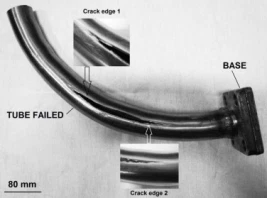
A high pressure oil tube with nominal diameter 50.8 mm and nominal thickness 4 mm has prematurely failed with a longitudinal crack. The failure was detected after 11 months of operation. The tube is part of the hydraulic power unit of an off shore oil and gas platform. The maximum designed internal pressure was 20 MPa and the service temperature was 25 °C with no significant variation. In practice, the internal pressure varies from 16 to 20 MPa under operation, and shutdowns rarely occur.
Read more

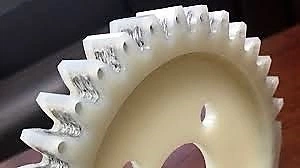
A Review on Failure Characteristics of Polymer Gear

gears_imagesPolymer are now widely used as substitute material for steel in low load devices. Its failure differs from gears made of steel, thus it is important to categorize the failures shown by polymer gears. Several previous studies noted that wear detection, microstructure surface condition monitoring, weight loss and temperature detection can be used in detecting failure of polymer gear. This article reviews the failure detection method mentioned above. Other researcher works were studied and their findings were extracted in order to identify the methods they used. The most common method used was wear detection and it was supplemented by other methods such as microstructure surface condition monitoring. Failures shown by polymer can be concluded to be tooth breakage, tooth deformation, material removal and surface fatigue.

Read more

Fatigue Failure Analysis of Rim

thikf9m1kxA new article published in the « International Research Journal of Engineering and Technology« , Aug-2016.

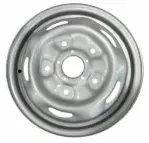
A Finite Element Method methodology is proposed for fatigue life and failure prediction of automotive steel wheel by the simulations of dynamic radial fatigue test (RFT). A short review of theoretical models, numerical simulation models were described in conjunction with bilinear elasto-plastic finite element stress analysis under wheel rotating loading.

Read more …

Failure of high-chromium iron roll in compact strip production MILL

2016-12-08_11h16_13A case study published in « Case Studies in Engineering Failure Analysis« , july 2013.

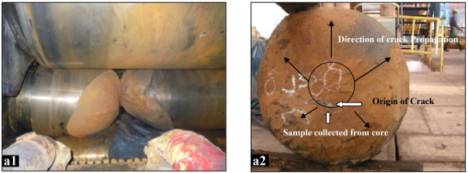
A high chromium (HiCr) iron work roll broke in three pieces in finishing stand 4 in a compact strip production (CSP) mill of a steel company. The paper describes the causes of the roll failure manufactured from high chrome grade steel along with the precautionary measure.

Read more …

Investigation of turbine blade failure in a thermal power plant

1-s2-0-s2213290213000333-gr2A paper published in « Case Studies in Engineering Failure Analysis« , july 2013

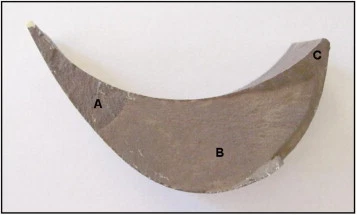
The present work reports an investigation of a failure in a blade in the LP stage of a thermal power plant of 310 MW. After opening the turbine casing, one blade in the LP region was found fractured. The main damage occurred in the blade row 36 which is the L-3 row of the flow in the turbine side. The key objective of this paper was to identify the root of the failure.

Read more …

An investigation on the corrosion of flue gas sensor in boiler stack

2016-12-08_11h01_42A  paper published in « Case Studies in Engineering Failure Analysis« , July 2013

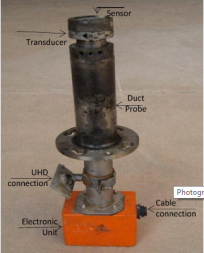
A commercial gas velocity sensor used for flue gases monitoring was subject to severe corrosion failure. An investigation was conducted based on visual inspection, microstructural study and SEM observation coupled to EDX analysis. A combination of mechanisms was proposed including a dominating severe dew point corrosion for both transducer and its covering, galvanic attack and an eventual hydrogen attack for the transducer side part. Recommendations were proposed to avoid a future severe damage to such type of sensor including an insulation between transducer and covering metals and an up-grade of the titanium alloy used.

Read more ….

Cas Concrets-Arbres : ruptures brutales ou par fatigue

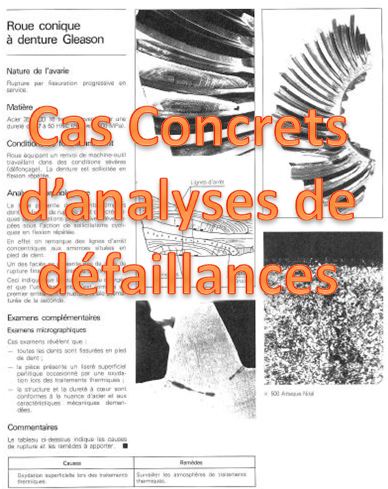
Avatar Cas ConcretsArbres de transmission de couples ou axes de rotation, voici trois cas concrets de ruptures d’arbres ayant des origines différentes : problème de matière, d’usinage, de sollicitations anormales.

Ces trois fiches d’analyse de défaillance avaient été publiées en 1979 dans Cetim-information.

Pour lire la fiche : Cliquez ici.

Vintage-La rupture en service des assemblages vissés

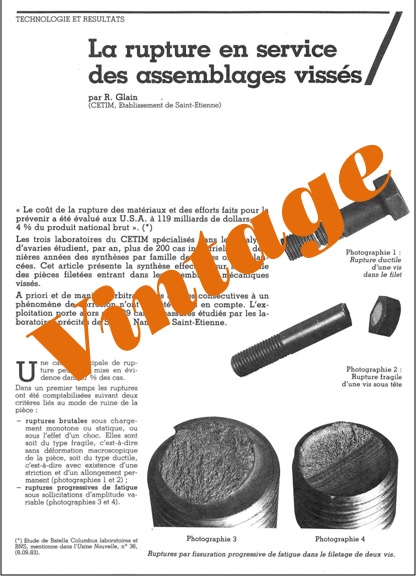
Vintage assemblages vissesLes experts en analyse de défaillances du Cetim ont réalisé courant 1988 une étude statistique de 139 cas de ruptures d’assemblages vissés. Les résultats ont montré que pour les deux tiers des cas traités, 53 % des cas de rupture est dû à un phénomène de fissuration progressive et 47 % correspond à des ruptures brutales. Pour le tiers restant, plusieurs causes  conjuguées étaient à l’origine des défaillances.

telecharger le doc


Failure analysis of Rocker liner used as a charging system of blast furnace

2016-12-08_10h04_01      2016-12-08_10h05_28

An article published in « Case Studies in Engineering Failure Analysis« , July 2013.

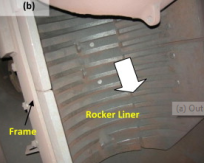
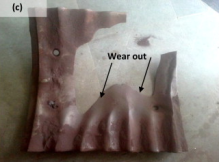
In this study, failure analysis of rocker liners used for charging system of blast furnace was carried out. The failed rocker liner samples shows non-uniform distribution of carbides, resulted in variation of hardness as well as wear properties. In the case of failed sample, the reason for the poor wear resistance of the component was due to the non-uniform carbide in pearlitic matrix.

Read more …

Sulfide stress corrosion cracking and hydrogen induced cracking

1-s2-0-s2213290213000424-gr11-s2-0-s2213290213000424-gr2

A case study published in « Case Studies in Engineering Failure Analysis » on www.sciencedirect.com.

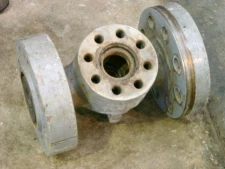
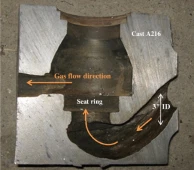
The wellhead flow control valve bodies which are the focal point of this failure case study were installed in some of the upstream facilities of Khangiran’s sour gas wells. These valve bodies have been operating satisfactorily for 3 years in wet H2S environment before some pits and cracks were detected in all of them during the periodical technical inspections. During investigation many cracks were observed on the inner surface of the valve body grown from the surface pits. The results indicate that flow control valve body failed due to combination of hydrogen induced corrosion cracking (HICC) and sulfide stress corrosion cracking (SSCC). According to HIC and SSC laboratory tests and also with regard to cost of engineering materials, it was evident that the best alternative for the valve body alloy is A217-WC9 cast Cr–Mo steel.

Read more