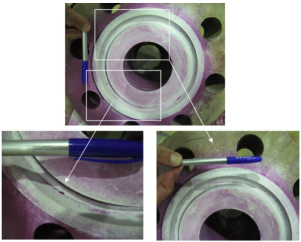
An investigation of cracking causes in an outlet RTJ flange in ISOMAX unit

2016-11-16_18h55_18A paper published in « Case Studies in Engineering Failure Analysis« , available on sciencedirect.com.

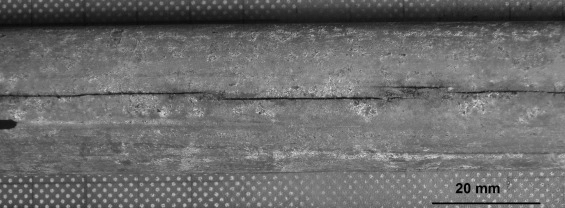
Corrosion has always been a problem in the petroleum refining and the petrochemical operations. The equipment of ISOMAX unit, such as reactors, furnace tubes, valves, and pipelines are frequently performed at high temperatures and high pressure condition. This working conditions, accelerates the failures due to corrosion. Therefore, heat- and corrosion-resistant alloys, e.g., austenitic stainless steels, have been widely used in this unit because of their excellent corrosion resistance, mechanical strength and toughness.

This paper describes failure analysis procedure of a cracked high pressure 321 SS RTJ flange in ISOMAX unit. In order to get conclusions related to crack propagation mechanisms of the flange, some investigations were done on the cracked flange that is mentioned in the body of the paper.
Read more …

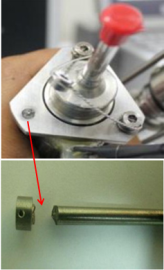
Failure analysis of titanium alloy fasteners for aerospace applications

2016-11-16_18h46_14A paper published in « Case Studies in Engineering Failure Analysis« , available on sciencedirect.com.

As a qualification of bolt for flight assembly, the bolt assembly has undergone proof pressure test at 2.4 MPa, Vibration test at frequency range of 20–100 Hz, ±3 db/oct for 120 s in both lateral and longitudinal directions and flight acceptance test. During routine visual inspection before electrical check, it was observed in one of the three fasteners that the head of the bolt had got sheared off from the shank portion of bolt. Further, a failure analysis was carried out on the failed bolt.

The objective of the study is metallurgical analysis of the failed bolt, fractography study to find out the root cause of the failure, and optimization of processing parameters for fastener manufacturing.

Read more ….

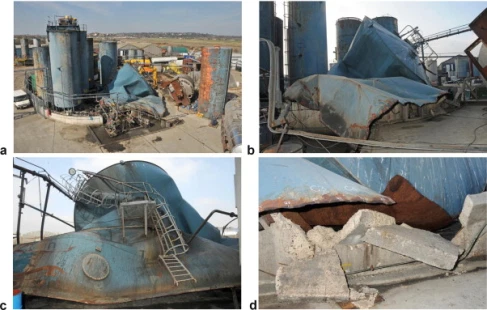
Catastrophic failure of a carbon steel storage tank due to internal corrosion

A paper published in « Case Studies in Engineering Failure Analysis« , available on sciencedirect.com.

Catastrophic failure of a 10 m high, 8 m diameter steel storage tank containing approximately 350 m3 of waste solvent led to a significant environmental incident in 2009. An investigation was carried out to establish the root cause and to learn lessons that might prevent a reoccurrence.

Read more …

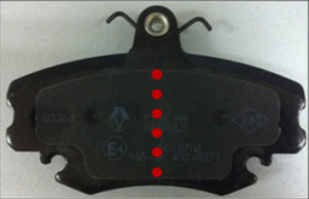
Non-Destructive Investigation of Bulk Residual Stress in Automobile Brake Pads with its Service Life

2016-11-16_18h02_45A paper published in « Journal for Foundations and Applications of Physics »,  available online at sciencefront.org.

Automobile brake systems transform kinetic energy into heat for the purpose of speed control. During this operation, rapid heating and cooling cycles cause the formation of residual stress in the brake pad backing plate. In this study, the relation between residual stress magnitude and the operation period is investigated to predict the service life of brake pads. ….

More at : http://sciencefront.org/ojs/index.php/jfap/article/view/45/34

Design and fabrication of Impact Die for Powder Metallurgy

2016-11-16_17h43_25A paper publihed in « Materials Today: Proceedings », available online at www.sciencedirect.com

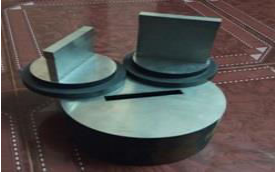
Die design is one of the most important steps in Powder Metallurgy process because the shape and attributes of the die will directly affect the final component. Die design has a number of steps and considerations to be made before fabrication. This project is an attempt to design and fabricate a die for cold compaction process used in the powder metallurgy process.

More at :  http://www.pmme.co.in/papers/EMT-388.pdf

Rolling element bearing failure analysis: A case study

A paper published in « Case Studies in Engineering Failure Analysis« , january 2013

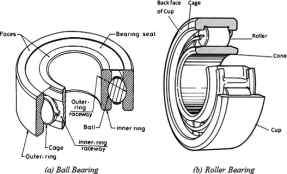
This paper addresses Rolling Contact Fatigue (RCF) occurs due to the result of cyclic stress developed during operation and mechanism that involve in fretting failure of rolling element bearing. As bearing raceways of non-rotating rolling element bearings exposed to vibration or sliding oscillation false Brinelling occurs. Bearing surface due to false Brinelling tends to damage within a short period, due to cavities created on the bearing raceway. Recommendation towards enhancement of bearing life is also suggested.

Read more …

Cracking of underground welded steel pipes caused by HAZ sensitization

An article on case study, published in « Case Studies in Engineering Failure Analysis« , on january 2013.

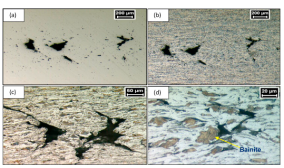
Low alloy steel welded pipes buried in the ground were sent for failure analysis investigation. Failure of steel pipes was not caused by tensile ductile overload but resulted from low ductility fracture in the area of the weld, which also contains multiple intergranular secondary cracks. The failure is most probably attributed to intergranular cracking initiating from the outer surface in the weld heat affected zone and propagated through the wall thickness.

Read more ….

Metallurgical investigation of different causes of center bursting led to wire breakage during production

2016-11-03_09h22_22A case study published in « Case Studies in Engineering Failure Analysis« , on january 2013.

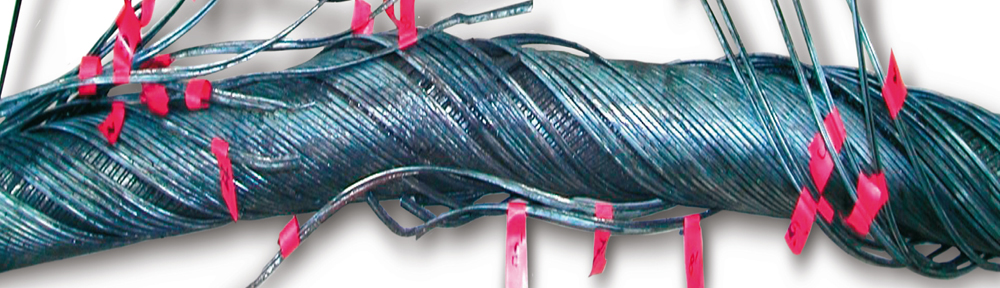
Central bursting cause problem as it is hard to detect by means of surface check. In this paper, three broken wires which failed during production were investigated. In first two wires breakage took place due to formation of hard and brittle phase. In third case failure took place due to inappropriate drawing operations.

Read more

Analysis of corroded elbow section of carbon steel piping system of an oil–gas separator vessel

An interessant case study published in « Case Studies in Engineering Failure Analysis« , on 09january 2013.

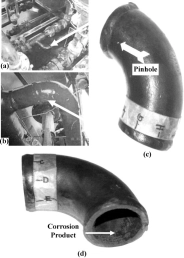
A pinhole in elbow section of oil piping system is formed by localized corrosion. The corrosion is found to result from sequential chlorination and sulfidation reactions : the chlorination results from hydrolysis of calcium chloride in the crude oil and the sulfidation results from hydrogen sulfide in the crude oil.

Read more …

Guide d’aide au choix des matériaux résistant à l’eau de mer

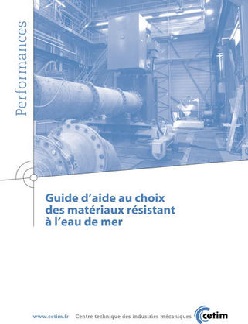
Cet ouvrage du Cetim est un guide d’aide au choix des matériaux résistants à l’eau de mer.

Il synthétise les informations nécessaires pour sélectionner, en toute connaissance de cause, les solutions les mieux adaptées à la réalisation de pompes ou d’équipements pour des applications en milieu marin. Le guide est structuré selon une approche logique commençant par l’expertise d’une défaillance afin d’en déterminer la corrosion responsable ou par la prévision du type de corrosion susceptible d’apparaître en cours d’utilisation. Suivent la description des caractéristiques de l’eau de mer et des processus conduisant à la corrosion et une revue des différents matériaux utilisés en milieu marin: aciers non ou faiblement alliés, fontes, aciers inoxydables, alliages d’aluminium, de cuivre, de nickel et de titane. Le guide propose enfin quelques règles de conception et moyens de protection envisageables ainsi qu’une classification des matériaux vis-à-vis de leur résistance à la corrosion,au travers d’une série de fiches résumant leurs caractéristiques principales à prendre en compte.

Pour retrouver et commander cet ouvrage cliquez ici