Erosion-Corrosion Behavior and Failure Analysis of Offshore Steel Tubular Joint

Capture electrochemsci vol8A new publication of the International Journal of Electrochemical ScienceMay 1, 2013  

An extensive investigation into the erosioncorrosion behavior and failure analysis of an offshore steel tubular joint has been carried out by various electrochemical techniques, visual inspection, optical microscope examination, mechanical testing, microstructure examination, chemical analyses, Scanning Electron Microscope (SEM) examination, Finite Element Analysis (FEA) and Computational Fluid Dynamics (CFD).

For further informations click : www.electrochemsci.org/papers/vol8/80507187.pdf

Failure analysis of conveyor pulley shaft

Via Sciencedirect.com : A failure analysis was performed on the shaft of a conveyor belt drive pulley. The shaft failed after seven days in service. Failure mechanism was high cycle fatigue. Failure occurred due to improper reconditioning of the shaft.

Etude sur les causes de fissuration d’une bride à joint annulaire

Dans les unités de traitement d’eau à haute pression, l’équipement et la tuyauterie sont fournis avec des brides à joint annulaire pour assurer joints sans fuite. La plupart de ces brides sont faites en acier inoxydable austénitique types 321SS ou 347SS. L’étude rapportée par Sciencedirect.com décrit l’analyse de défaillance de brides fissurées d’un four de chauffe placé devant le réacteur dans l’unité ISOMAX. Le matériau de la bride est un acier 321 SS. L’inspection visuelle, le ressuage, la microscopie optique et des tests EDS (spectroscopie à dispersion d’énergie) ont été utilisés pour cette analyse. Les résultats obtenus montrent que le mécanisme de fissuration trouve son origine dans une corrosion sous tension (SCC) en milieu chloruré. La source de chlorure est de la graisse anti-grippage qui est utilisée pour une étanchéité complète.

Rupture brutale d’une vanne à bille de grandes dimensions

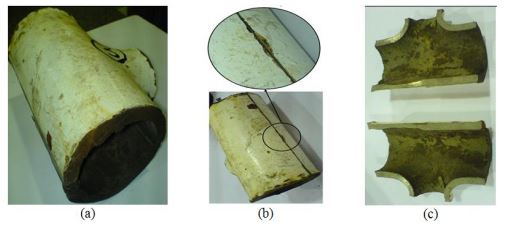
ScienceDirect.com – Engineer Failure Analysis rapporte une étude de cas de rupture brutale fragile survenue au cours des essais préliminaires en laboratoire sur le corps d’une vanne à bille destinée à un pipe-line sous-marin. La rupture s’est produite sous une pression inférieure à la valeur de calcul. La rupture, de type fragile, est située au niveau d’un raccordement. Les résultats de l’analyse de la défaillance mettent en cause deux facteurs concomitants : un sévère effet d’entaille et un traitement thermique incorrect.
 

Failure Analysis of a Rubber Hose in Anhydrous Ammonia Service

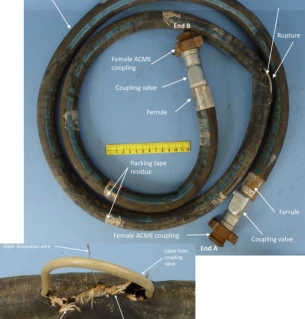
In July 2009, a fiber-reinforced rubber hose ruptured while being used to transfer liquid ammonia from a cargo tank truck to a storage tank. The rupture released ammonia vapor that drifted across a highway and through a neighborhood. As a result, one person was fatally injured and seven others required medical treatment.

This case history presents the failure analysis of the ruptured fiber-reinforced rubber transfer hose and focuses on the techniques used in the investigation. In particular, this case demonstrates how fractography can be applied to reinforced rubber and how Fourier transform infrared spectroscopy can be used to determine ammonolysis failure of fiber-reinforcement polymers.

via : ScienceDirect.com – Case Studies in Engineering Failure Analysis – Failure Analysis of a Rubber Hose in Anhydrous Ammonia Service.

Elevator chain wheel shaft break analysis

chain wheel shaft is made of normalized steel C45 without heat treatment of the surface. Due to dimensional nonconformity of composing elements of wedge assembly and due to soft shaft surface, at local indenting of the edge of the gear-wheel hub keyway, a small mechanical surface damage occurred on the shaft that resulted in a crack initiation. The outcome of its slow growth, induced by rotation and rather low dynamic tensile-compressive stresses is a final break of the shaft caused by material fatigue.

via : ScienceDirect.com – Case Studies in Engineering Failure Analysis – Elevator chain wheel shaft break analysis.

Failure Investigation of the Bucket Wheel Excavator Crawler Chain Link

The high mobility of open pit machines in heavy duty conditions provides fertile ground for the occurrence of various failures of the traveling mechanisms’ vital parts such as chain links. The goal of the study presented in this paper was to diagnose the cause of the damage of the bucket wheel excavator crawler chain links. In order to identify the reasons behind chain link failures, stress state calculations were performed as well as experimental investigations which, given the nature of the failure, included visual and metallographic examinations, chemical composition analysis and tests of mechanical properties. Based on the results of the numerical-experimental analyses, it was concluded that the chain link breakdowns are caused by ‘manufacturing-in’ defects. The results of the presented analyses also emphasize the importance of a comprehensive quality control of chain links.http://www.sciencedirect.com/science/article/pii/S1350630713001611

Metallurgical failure analysis of acetabular metal-backed screws

Sur ScienceDirect.com un cas concret d’analyse de défaillance de vis de fixation de cotyle rompues. C’est un article à paraître en septembre 2013 dans la revue Engineering Failure Analysis : Metallurgical failure analysis of acetabular metal-backed screws.
Survey of fatigue failures in helicopter components and some lessons learnt

Via ScienceDirect.com, un article à paraître dans Engineering Failure Analysis, concernant une enquête sur ruptures de fatigues de composants d’hélicoptères- Survey of fatigue failures in helicopter components and some lessons learnt.