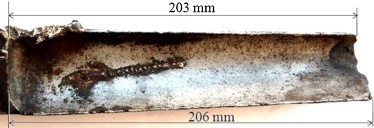
Des fissures dans un tuyau d’alimentation en huile ont causé une explosion dans un moteur sur un A380-900 de la Qantas en 2010.
Le Bureau de la sécurité des transports australien (ATSB) a publié son troisième et dernier rapport sur l’accident, après avoir constaté que les tuyaux d’alimentation en huile du moteur n° 2 de l’A380 n’était pas conforme aux spécifications de conception. L’ATSB a constaté que la panne moteur était le résultat d’une fissure de fatigue dans un tuyau d’alimentation en huile. Ce tuyau n’avait pas l’épaisseur de paroi requise.
Depuis l’incident, Rolls-Royce, les organismes de réglementation de l’aviation, et les opérateurs de A380 900 ont pris une série de mesures pour s’assurer que les moteurs avec tubulures d’alimentation en huile mal fabriquées ont été retirés du service ou fixés de manière que l’avion pourrait fonctionner en toute sécurité.
WordPress:
J'aime chargement…

 Case study of stainless steel components of a geothermal heating system failed prematurely. The crack surfaces were brittle in appearance and were predominately transgranular. The failure was determined to be caused by chloride induced stress corrosion cracking. Subsequent failures may be avoided by informed alloy selection.
 High pressure pipe failed by fatigue in the fusion line of longitudinal weld.
 In this study, failure analysis of rocker liners used for charging system of Blast Furnace was carried out. The failed rocker liner samples shows non-uniform distribution of carbides, resulted in variation of hardness as well as wear properties. After proper heat-treatment and chemistry modification, the Rocker Liner obtained high hardness (with uniformity) due to proper distribution of carbide phases in the tempered martensitic matrix. Thus proper heat treatment is needed to achieve optimum property with changing the material composition to deal with this stringent working condition. Rocker liner with modified microstructure was trailed in the Blast Furnace and it has given a life of around 20-22 months life.
 The damage of the inelastic coating was more serious than the elastic coating. The failure causes of the antistatic coating on the radome were analyzed. The results show that the failure of inelastic and elastic antistatic coatings was caused by particles erosion, and the aging of the coatings accelerated the failure of coatings. The elastic coating had better anti-erosion ability than the inelastic coating because of its high fracture elongation and good elastic deformation, so its damage was lighter than the inelastic coating.
 Highlights :
 Experiment results showed that the superficial heat treatment of the pinion was not uniform and there was no hardened layer at the tooth root. At the same time, the hardened layer near the pitch circle had been worn out for long-term service, thus the surface hardness of the failed pinion was lower than that of the rack