Case study of severe strip breakage in rolling mill

2016-08-30_12h43_54A case study published in « Case Studies in Engineering Failure Analysis » – april 2016.

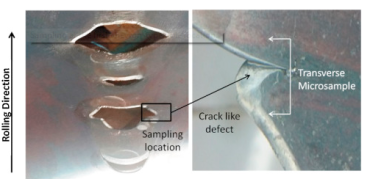
In this paper, a case of severe strip breakage in rolling mill of Thin Slab Casting and Rolling (TSCR) shop of TATA Steel, Jamshedpur is presented. Visual observation revealed complete splitting with material missing along the central axis of the strip. Presence of defects in form of white stringers, white patches and holes were observed along the same axis just ahead of split location.
Read more

Failure analysis of tube-to-tubesheet welded joints in a shell-tube heat exchanger


An article in progress in « Case Studies in Engineering Failure Analysis », Volume 7 (october 2016).

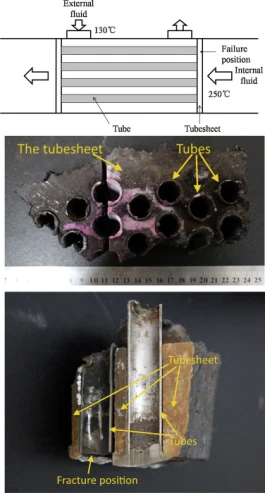
In this work, fracture failure of a shell-tube heat exchanger at the tube-to-tubesheet welded joints was investigated. Fatigue started at initial defects of the welded joint was confirmed as the failure mechanism of the heat exchanger. Bad welding and unsuitable expansion gave rise to the formation of initial cracks. The alternating stress comes from various reasons such as the resonant vibration.

Read more

Failure analysis of a diesel generator connecting rod

2016-07-05_16h55_33

An article in progress in « Case Studies in Engineering Failure Analysis », Volume 7 (october 2016).


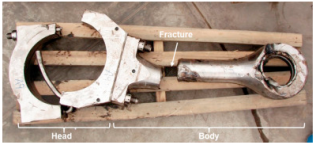
This paper presents the results of a failure analysis investigation conducted in a connecting rod from a diesel engine (18 V, four-stroke) used in the generation of electrical energy. The continuous output of the engine was 10.5 MW, at 600 rpm ; before the failure of the con-rod it accumulated 35836 service hours, working with a load factor of 80%.

Read more

Failure analysis of a half-shaft of a formula SAE racing car

2016-07-05_16h47_58An article in progress in « Case Studies in Engineering Failure Analysis », Volume 7 (october 2016).

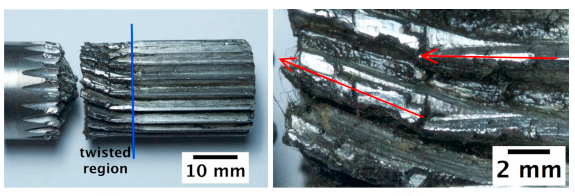
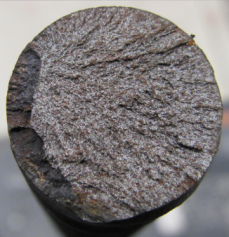
The formula SAE is a competition among students worldwide, where they are challenged to design, build and test a small formula-type racing car, following rules and specifications defined by the Society of Automotive Engineers (SAE). In the present analysis, a premature failure of a half-shaft of the transmission system of a racing car occurred after circa 100 km of use. The results show that the alloy steel bar used for the half-shaft did not follow specifications, with a consequent lower strength and resulting in a material with insufficient loading capacity and fatigue resistance. As a consequence, the fracture process was a confluence of torsional fatigue crack propagation and overload ductile fracture through the spline section of the half-shaft.

Read more

Failure analysis of a cracked aluminum 7075 wing internal angle in Airbus A-300

2016-07-05_16h39_20


An article in progress in « Case Studies in Engineering Failure Analysis », Volume 7 (october 2016).


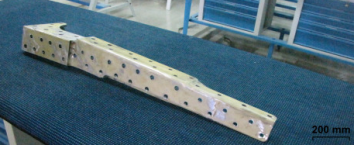
There are 16 angles in Airbus A300s wing box. On the right side, rear spur, and lower flange area of the center wing box, one of these angles had been cracked with a length of 28 mm. This crack has decreased residual strength of the part under allowed values and resulted to a rupture in the rear spur lower cap. Several reports of the same occurrences in other Airbus A300 air crafts, highlight the importance of finding the causes of this failure.  Finally, it was concluded that corrosion fatigue was the main reason which itself comes from manufacturing, maintenance, metallurgical, and geometric reasons as were discussed in this study.

Read more

Root cause analysis (RCA) of fractured ASTM A53 carbon steel pipe at oil & gas company

2016-07-05_16h25_54

An article in progress in « Case Studies in Engineering Failure Analysis », Volume 7 (october 2016).


Incident involving failures of ASTM A53 carbon steel pipe, connected to pressure safety valve and carrying raw gas has caused serious supply disruption. This study was performed to identify the most probable cause of the pipe failure.

Read more

Perforated mechanism of a water line outlet tee pipe

tuyauAn article published in « Case Studies in Engineering Failure Analysis« , Volume 4, October 2015.

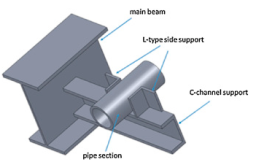
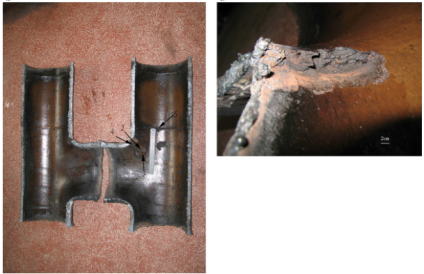
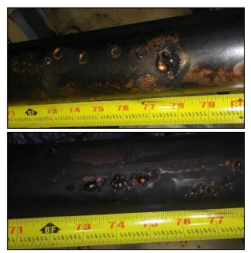
A corroded tee pipe belonging to a 10-in new separator water line outlet installed in an offshore oil well drilling rig was investigated. The configuration of the large corroded pit had the shape of an imperfect horse’s hoof with a completely corroded interior and a honeycomb-like cavity. There is a badly corroded pit at the welded seam at the joint connecting the tee pipe and flange. The penetrating puncture hole at the turn of the tee pipe is likely the result of cavitation erosion accompanied by chemical/electrochemical corrosion, and the corrosion on the seam connecting the tee pipe and flange is likely the result of electrochemical corrosion.

Read more

Stress corrosion cracking of full sized rockbolts

2016-06-04_07h48_16An article published in  « International Journal of Rock Mechanics & Mining Sciences – 81 (2016)« .

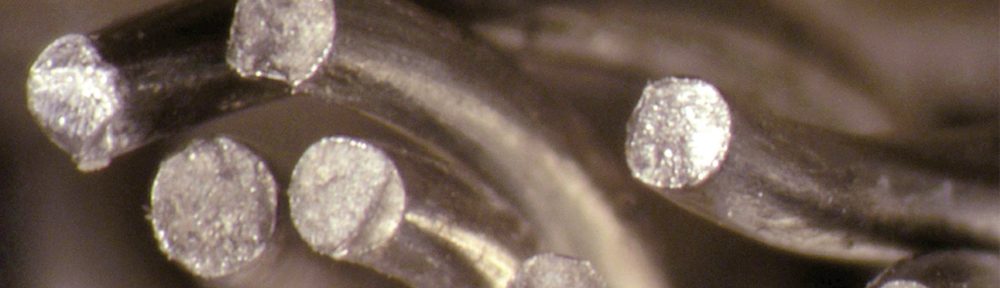
Previous studies had identified that a testing protocol was required to examine stress corrosion cracking (SCC) of full sized rockbolts under simulated in situ conditions. It was found that SSR testing provided an appropriate analogue for examining rockbolt susceptibility to SCC and was thus used to examine the effect of grit blasting, galvanising and varying steel grades on the SCC resilience of rockbolts. Of these, 300 grade steel and galvanising provided the most promising resistance to SSC, while grit blasting provided a 40% improvement in resistance compared to untreated HSAC 840 grade rockbolts.

More

Failure investigations of a 900 KV bil trench cota bushing

A case study of failure discussed in the 82 nd International Conference of Doble Clients.

bushingThe discussion of this paper will focus on the H1 Trench COTA bushing, which failed after field maintenance handling that would not normally be expected to have a negative effect on a bushing. Following the failure, the top air side porcelain was found ruptured and missing; the bottom insulator was fractured into a number of pieces. The H2 and H3 bushings from this transformer, which were identical Trench type bushings, were also removed and disassembled for inspection to help identify a possible root cause of the H1 bushing failure.

More at : http://www.doble.com/content/show/boston2015/files/BIIT/BIIT-2_Trench_COTA_Failure_Root_Cause_Mani.pdf


Fatigue Failure of Aluminium Alloy Piston

An article published in International Research Journal of Engineering and Technology (IRJET), Volume: 03 Issue: 04 | Apr-2016.
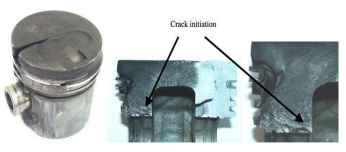
pistonAn analytical study was performed about piston failure by fatigue. Fatigue cracks are initiated and propagated by the action of mechanical and high temperature loading conditions which induces cyclic stresses in the piston material.  Various proposals and solutions are presented so that necessary care can be taken to prevent piston failure in future.

Read more