A study of the preload force in metal-elastomer torsion springs

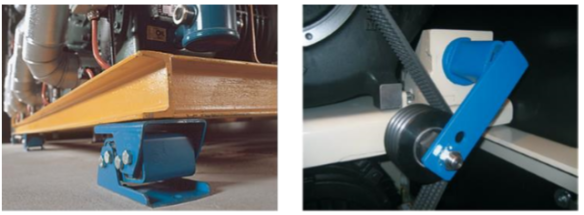
neidhart-springsNeidhart type suspension units composed of metal-elastomer torsion springs can be a good alternative to steel helical springs in applications such as vibration absorbers or vehicle suspension systems. Assembling this type of spring requires initial preload of the elastomeric working elements, which determines their operating properties.The results of experimental tests and numerical simulations concerning the preload of elastomeric working elements in Neidhart type suspension units are presented in the paper. The performed research made it possible to propose a new calculation model for determining the preload force value acting on the elastomeric cylindrical elements applied in this type of suspension unit. The results obtained using the proposed model exhibit good convergence with FEM simulation results within the range of the tested geometrical and material properties.

Read more …

Fatigue cracking of high pressure oil tube

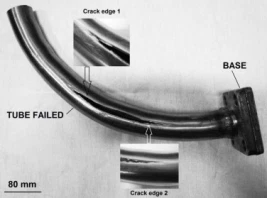
1-s2-0-s2213290213000321-gr1An article about a Case study of failure analysis published in « Case Studies in Engineering Failure Analysis« , July 2013.

A high pressure oil tube with nominal diameter 50.8 mm and nominal thickness 4 mm has prematurely failed with a longitudinal crack. The failure was detected after 11 months of operation. The tube is part of the hydraulic power unit of an off shore oil and gas platform. The maximum designed internal pressure was 20 MPa and the service temperature was 25 °C with no significant variation. In practice, the internal pressure varies from 16 to 20 MPa under operation, and shutdowns rarely occur.

Read more

Failure of high-chromium iron roll in compact strip production MILL

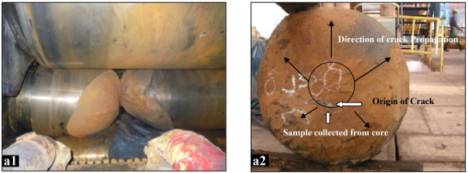
2016-12-08_11h16_13A case study published in « Case Studies in Engineering Failure Analysis« , july 2013.

A high chromium (HiCr) iron work roll broke in three pieces in finishing stand 4 in a compact strip production (CSP) mill of a steel company. The paper describes the causes of the roll failure manufactured from high chrome grade steel along with the precautionary measure.

Read more …

Investigation of turbine blade failure in a thermal power plant

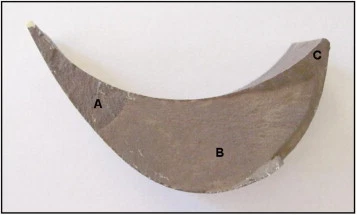
1-s2-0-s2213290213000333-gr2A paper published in « Case Studies in Engineering Failure Analysis« , july 2013

The present work reports an investigation of a failure in a blade in the LP stage of a thermal power plant of 310 MW. After opening the turbine casing, one blade in the LP region was found fractured. The main damage occurred in the blade row 36 which is the L-3 row of the flow in the turbine side. The key objective of this paper was to identify the root of the failure.

Read more …

An investigation on the corrosion of flue gas sensor in boiler stack

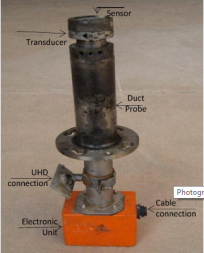
2016-12-08_11h01_42A  paper published in « Case Studies in Engineering Failure Analysis« , July 2013

A commercial gas velocity sensor used for flue gases monitoring was subject to severe corrosion failure. An investigation was conducted based on visual inspection, microstructural study and SEM observation coupled to EDX analysis. A combination of mechanisms was proposed including a dominating severe dew point corrosion for both transducer and its covering, galvanic attack and an eventual hydrogen attack for the transducer side part. Recommendations were proposed to avoid a future severe damage to such type of sensor including an insulation between transducer and covering metals and an up-grade of the titanium alloy used.

Read more ….

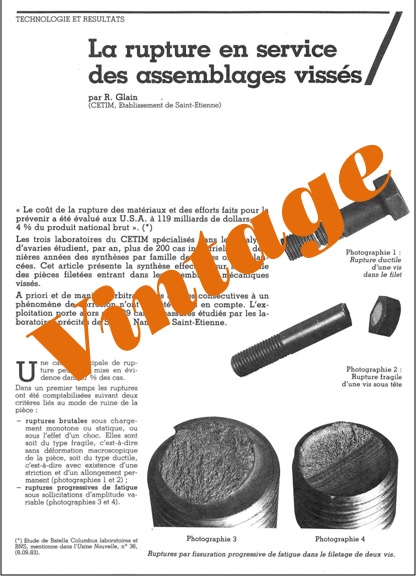
Vintage-La rupture en service des assemblages vissés

Vintage assemblages vissesLes experts en analyse de défaillances du Cetim ont réalisé courant 1988 une étude statistique de 139 cas de ruptures d’assemblages vissés. Les résultats ont montré que pour les deux tiers des cas traités, 53 % des cas de rupture est dû à un phénomène de fissuration progressive et 47 % correspond à des ruptures brutales. Pour le tiers restant, plusieurs causes  conjuguées étaient à l’origine des défaillances.

telecharger le doc


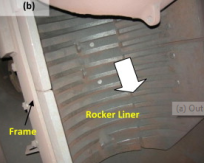
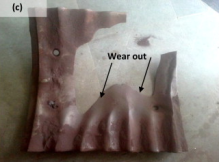
Failure analysis of Rocker liner used as a charging system of blast furnace

2016-12-08_10h04_01      2016-12-08_10h05_28

An article published in « Case Studies in Engineering Failure Analysis« , July 2013.

In this study, failure analysis of rocker liners used for charging system of blast furnace was carried out. The failed rocker liner samples shows non-uniform distribution of carbides, resulted in variation of hardness as well as wear properties. In the case of failed sample, the reason for the poor wear resistance of the component was due to the non-uniform carbide in pearlitic matrix.

Read more …

Sulfide stress corrosion cracking and hydrogen induced cracking

1-s2-0-s2213290213000424-gr11-s2-0-s2213290213000424-gr2

A case study published in « Case Studies in Engineering Failure Analysis » on www.sciencedirect.com.

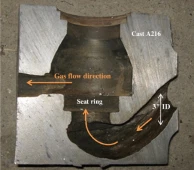
The wellhead flow control valve bodies which are the focal point of this failure case study were installed in some of the upstream facilities of Khangiran’s sour gas wells. These valve bodies have been operating satisfactorily for 3 years in wet H2S environment before some pits and cracks were detected in all of them during the periodical technical inspections. During investigation many cracks were observed on the inner surface of the valve body grown from the surface pits. The results indicate that flow control valve body failed due to combination of hydrogen induced corrosion cracking (HICC) and sulfide stress corrosion cracking (SSCC). According to HIC and SSC laboratory tests and also with regard to cost of engineering materials, it was evident that the best alternative for the valve body alloy is A217-WC9 cast Cr–Mo steel.

Read more

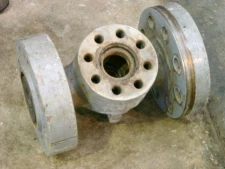
An investigation of cracking causes in an outlet RTJ flange in ISOMAX unit

2016-11-16_18h55_18A paper published in « Case Studies in Engineering Failure Analysis« , available on sciencedirect.com.

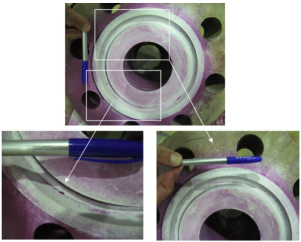
Corrosion has always been a problem in the petroleum refining and the petrochemical operations. The equipment of ISOMAX unit, such as reactors, furnace tubes, valves, and pipelines are frequently performed at high temperatures and high pressure condition. This working conditions, accelerates the failures due to corrosion. Therefore, heat- and corrosion-resistant alloys, e.g., austenitic stainless steels, have been widely used in this unit because of their excellent corrosion resistance, mechanical strength and toughness.

This paper describes failure analysis procedure of a cracked high pressure 321 SS RTJ flange in ISOMAX unit. In order to get conclusions related to crack propagation mechanisms of the flange, some investigations were done on the cracked flange that is mentioned in the body of the paper.

Read more …

Failure analysis of titanium alloy fasteners for aerospace applications

2016-11-16_18h46_14A paper published in « Case Studies in Engineering Failure Analysis« , available on sciencedirect.com.

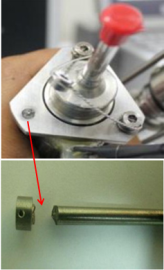
As a qualification of bolt for flight assembly, the bolt assembly has undergone proof pressure test at 2.4 MPa, Vibration test at frequency range of 20–100 Hz, ±3 db/oct for 120 s in both lateral and longitudinal directions and flight acceptance test. During routine visual inspection before electrical check, it was observed in one of the three fasteners that the head of the bolt had got sheared off from the shank portion of bolt. Further, a failure analysis was carried out on the failed bolt.

The objective of the study is metallurgical analysis of the failed bolt, fractography study to find out the root cause of the failure, and optimization of processing parameters for fastener manufacturing.

Read more ….