Root cause analysis (RCA) of fractured ASTM A53 carbon steel pipe at oil & gas company

2016-07-05_16h25_54

An article in progress in « Case Studies in Engineering Failure Analysis », Volume 7 (october 2016).


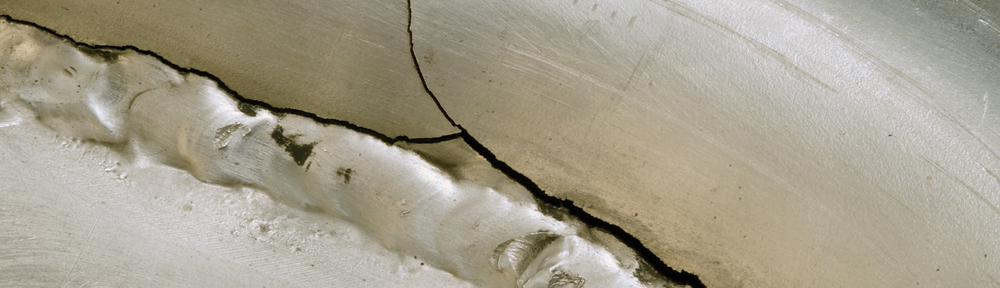
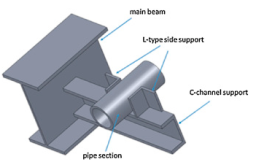
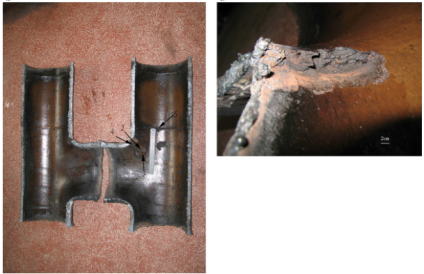
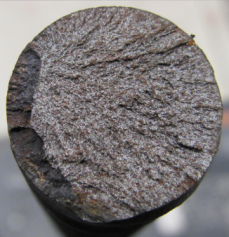
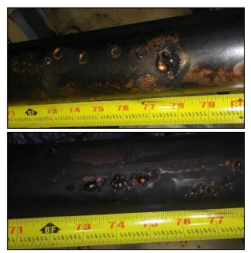
Incident involving failures of ASTM A53 carbon steel pipe, connected to pressure safety valve and carrying raw gas has caused serious supply disruption. This study was performed to identify the most probable cause of the pipe failure.

Read more

Formation – Analyse de défaillances : engrenages et roulements

Sol Formation Cetim 2016Comprenez les causes des défaillances de vos engrenages et roulements pour mieux les éviter. Mettez en œuvre des actions correctives appropriées en utilisant une démarche structurée d’analyse de défaillance. Une formation du Cetim à ne pas manquer en 2017 :du 12/09/2017 au 13/09/2017 à Senlis et du 16/11/2017 au 17/11/2017 à Mulhouse.

À l’issue de la formation, les participants pourront :

  • identifier les différents aspects des dentures et roulements des transmissions par engrenages en service ;
  • expliquer les mécanismes d’endommagement et identifier les causes des défaillances ;
  • proposer les actions correctives appropriées ;
  • échanger avec les experts du domaine.

Plus d’information et inscription

Perforated mechanism of a water line outlet tee pipe

tuyauAn article published in « Case Studies in Engineering Failure Analysis« , Volume 4, October 2015.

A corroded tee pipe belonging to a 10-in new separator water line outlet installed in an offshore oil well drilling rig was investigated. The configuration of the large corroded pit had the shape of an imperfect horse’s hoof with a completely corroded interior and a honeycomb-like cavity. There is a badly corroded pit at the welded seam at the joint connecting the tee pipe and flange. The penetrating puncture hole at the turn of the tee pipe is likely the result of cavitation erosion accompanied by chemical/electrochemical corrosion, and the corrosion on the seam connecting the tee pipe and flange is likely the result of electrochemical corrosion.

Read more

Stress corrosion cracking of full sized rockbolts

2016-06-04_07h48_16An article published in  « International Journal of Rock Mechanics & Mining Sciences – 81 (2016)« .

Previous studies had identified that a testing protocol was required to examine stress corrosion cracking (SCC) of full sized rockbolts under simulated in situ conditions. It was found that SSR testing provided an appropriate analogue for examining rockbolt susceptibility to SCC and was thus used to examine the effect of grit blasting, galvanising and varying steel grades on the SCC resilience of rockbolts. Of these, 300 grade steel and galvanising provided the most promising resistance to SSC, while grit blasting provided a 40% improvement in resistance compared to untreated HSAC 840 grade rockbolts.

More

Des joints qui durent vraiment plus longtemps

Étanchéité, nettoyabilité, endurance… Les nouveaux joints sélectionnés par Serac pour l’étanchéité dynamique de haut de cuve alimentaire durent huit à dix fois plus longtemps. Quant aux coûts, ils sont divisés par deux.

Pour en savoir plus, lire l’article dans le document joint.

telecharger le doc

Burst strength of glass fibre/epoxy composite pipes subjected to impact loading

An article discussed during the International Conference on Applications and Design in Mechanical Engineering 2015 (ICADME2015)
icadme2015

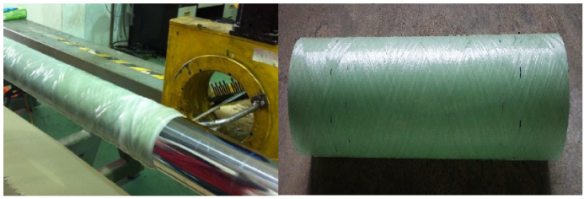
The main objective of this experimental study was to investigate the effects of low velocity impact loading on the pressure bearing capacity of the E-glass/epoxy composite pipes. The pipes were produced by the conventional filament winding technique comprises of six axisymmetric layers with (±55°)3 winding angles. The specimens were impacted at three different energy levels which are 5 J, 7.5 J, and 10 J using an instrumented drop weight impact testing machine (IMATEK IM10). The samples were then filled with water and subjected to burst test until distinct leakage failure is observed. The results indicate that the peak force and contact time increases with increased of impact energy. For impacted samples, the pressure tests show that the burst strength of the pipes decreases with increase in energy levels during impact loading. During the burst tests, several damage types named leakage and eruption were observed.

Read more

Failure investigations of a 900 KV bil trench cota bushing

A case study of failure discussed in the 82 nd International Conference of Doble Clients.

bushingThe discussion of this paper will focus on the H1 Trench COTA bushing, which failed after field maintenance handling that would not normally be expected to have a negative effect on a bushing. Following the failure, the top air side porcelain was found ruptured and missing; the bottom insulator was fractured into a number of pieces. The H2 and H3 bushings from this transformer, which were identical Trench type bushings, were also removed and disassembled for inspection to help identify a possible root cause of the H1 bushing failure.

More at : http://www.doble.com/content/show/boston2015/files/BIIT/BIIT-2_Trench_COTA_Failure_Root_Cause_Mani.pdf


Fatigue Failure of Aluminium Alloy Piston

An article published in International Research Journal of Engineering and Technology (IRJET), Volume: 03 Issue: 04 | Apr-2016.
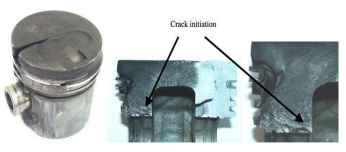
pistonAn analytical study was performed about piston failure by fatigue. Fatigue cracks are initiated and propagated by the action of mechanical and high temperature loading conditions which induces cyclic stresses in the piston material.  Various proposals and solutions are presented so that necessary care can be taken to prevent piston failure in future.

Read more

Catastrophic failure of a carbon steel storage tank due to internal corrosion

A case study of failure analysis published in « Case Studies in Engineering Failure Analysis« , october 2013.

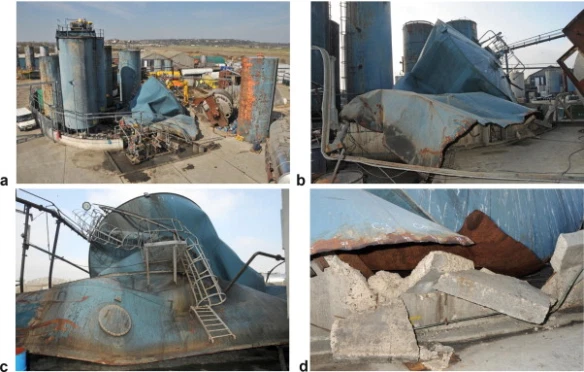
Catastrophic failure of a 10 m high, 8 m diameter steel storage tank containing approximately 350 m3 of waste solvent led to a significant environmental incident in 2009. An investigation was carried out to establish the root cause and to learn lessons that might prevent a reoccurrence.

Read more