
Etude collective sur la résistance à la cavitation par texturation de surface : appel à manifestation d’intérêt

logo CetimDans le cadre de la réalisation d’une étude sur la résistance à la cavitation des équipements fluidiques (pompes, compresseurs, vannes) par texturation de surface, et en vue d’accroître la synergie avec les industriels au plus près de leurs préoccupations, le Cetim appelle ceux-ci à se manifester. L’occasion de participer non seulement à une action impliquant plusieurs entreprises, permettant ainsi les échanges, mais également de pouvoir disposer immédiatement des résultats au fur et à mesure de l’avancement des travaux.

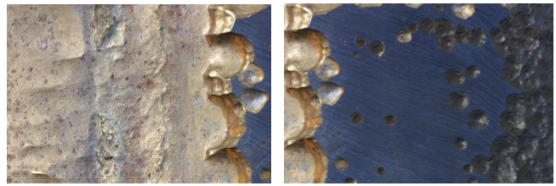
Cette étude s’intéressera en particulier à la problématique technique suivante : définir, pour une application donnée, les caractéristiques géométriques et les moyens de mise en œuvre d’une surface rainurée permettant de limiter l’usure par érosion et/ou par cavitation.

Pour participer, contactez le service SQR du Cetim au 03 44 67 36 82 ou par le lien suivant [email protected].
Source : Etude collective sur la résistance à la cavitation par texturation de surface : appel à manifestation d’intérêt – Cetim – Centre technique des industries mécaniques

Un industriel expert en corrosion grâce à Procor

2016-10-22_16h02_25

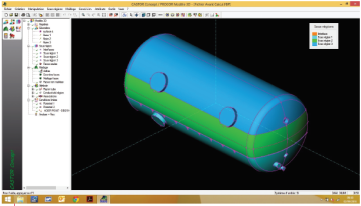
Le logiciel Procor acquis au Cetim par ECT lui permet d’optimiser la protection cathodique de ses filtres et réservoirs. Un atout concurrentiel.

Suite à un stage au Cetim sur la protection cathodique, Fabrice Aniel, le Président d’ECT, décide d’acheter Procor. Ce logiciel a été développé par le Cetim, dans le cadre d’un partenariat de recherche, pour optimiser la protection cathodique des installations métalliques en milieu aqueux.

Lire l’article : ECT – Cetim – Centre technique des industries mécaniques

Cas Concrets – Des défaillances par fissuration progressive

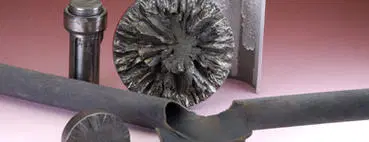
Des dizaines de milliers de cas ont été traités ces quarante dernières années par le Cetim, ses partenaires et centres associés. Cette expérience fait du Centre une référence dans le domaine à même d’intervenir dans tous les secteurs d’activités. Avec aujourd’hui ses centres associés et partenaires, l’Institut technologique Cetim met un ensemble de compétences et de moyens au service des industriels et experts pour analyser, comprendre et proposer des solutions permettant d’éviter la reproduction de ces défaillances.

 De nombreuses fiches d’analyse de défaillance ont été publiées, retrouvez les dans la Mécatech sur le site du Cetim.

Corrosion of Welded Joint in Alloy Steel Pipe

2015-11-15_10h33_54An interesting article published on 4 November 2015 in the International Journal of ELECTROCHEMICAL SCIENCE.

In this paper an investigation on corrosion behaviour of welded joints was performed to facilitate determination the causes of preferential degradation by corrosion of the welded metal (WM) and the heat affected zone (HAZ), in a welded pipeline of grade ASTM A355P5, used in a petrochemical plant as transfer line between a thermal cracking heater and a column which are part of an atmospheric distillation and vacuum (DAV) unit. It was found that the corrosion of the weld analyzed in this research has resulted due to its dendritic structure (pearlite, ferrite, complex carbide, bainite and martensite in localized areas), which reveals the lack of post welding heat treatment (PWHT). Read more …..


Mechanics of Collapse of WTC Towers

A telechargementpaper published in september 2016 on www.civil.northwestern.edu .

Abstract : The previously formulated model of the gravity-driven collapse of the twin towers of the World Trade Center on 9/11/2001 was shown to match all the existing observations, including the video record of the crush-down motion of the top part of tower during the first few seconds, the seismically recorded duration of collapse, the size distribution of particles caused by impact comminution of concrete floor slabs, the loud booms due to near-sonic lateral ejection velocity of air and dust, and precedence of the crush-down collapse mode before the crush-up. Nevertheless, di↵erent degrees of ductility, fracturing and end support flexibility of WTC columns could lead to an equally good match of these observations and remained uncertain, due to lack of test data. Recently, Korol and Sivakumaran reported valuable experiments that allow clarifying this uncertainty. They reveal that, under the assumptions of rigid end supports and unlimited ductility (or no fracturing), the energy dissipation in the WTC columns would have been at maximum 3.5-times as large as that calculated by the plastic hinge mechanism normally considered for small deflection buckling. This increase would still allow close match of all the aforementioned observations except for the first two seconds of the video. The proper conclusion from Korol and Sivakumaran’s tests, based on close matching of the video record, is that the fracturing of columns and the flexibility of end restraints must have significantly reduced the energy dissipation in columns calculated under the assumptions of no fracture and no end restraint flexibility.

Read more

Undercutting Formation Mechanism in Gas Metal Arc Welding

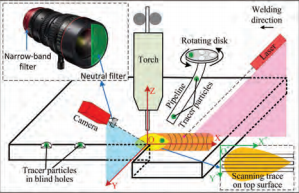
2016-06-04_07h59_57A vision­based sensing system was improved to acquire 2D images of weld pool shape and tracer particle movement simultaneously. …..

Based on analysis of tracer particle movement, roles of different associated forces, such as gravity, arc drag force, Maragoni force, magnetic force, droplet impact, and viscous force, were investigated. The results show that liquid metal under the arc decreases to a thin liquid layer if the welding speed is more than 1.0 m/min. This phenomenon makes viscous resistance increase in the thin liquid layer, which impedes transverse spreading of liquid metal. Thus, it is difficult for the weld toe to be filled by molten metal. Meanwhile, experiments revealed the amount of forward molten metal can be ignored in the front and middle of the weld pool. Therefore, it is difficult for the weld toe to be filled by the backward molten metal. As a result, undercutting defects appear during high­speed welding……..

More

Analyse de défaillance : une démarche de progres

L’analyse de défaillance est un processus méthodique permettant un diagnostic efficace des causes des différents modes de défaillance: rupture, usure, corrosion. La connaissance des origines des avaries facilite la mise en œuvre d’actions correctives et préventives afin qu’elles ne se reproduisent pas.

Pour l’industriel, fabricant ou utilisateur, une défaillance a souvent de lourdes conséquences :
– arrêt de production et pertes d’exploitation,
– litiges commerciaux et baisse d’image de marque,
– accidents humains,
… donc des conséquences financières!

Les experts Cetim et de ses centres associés : Cetim-Cermat, Cetim-Certec, Cetim-Ctdec, et partenaires : LRCCP(Laboratoire de Recherches et de Contrôle du Caoutchouc et des plastiques)ont avant tout un rôle de conseil !

Sollicitez les, ils vous accompagneront dans votre démarche !

Failure Analysis and Recovery of a 50-mm Highly Elastic Intermetallic NiTi Ball Bearing for an ISS Application

2016-09-21_21h33_08Read the full text of an article reported on NASA Technical Reports Server

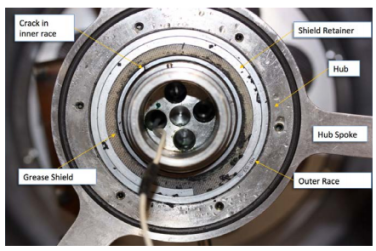
Ball bearings used inside the ISS Distillation Assembly centrifuge require superior corrosion and shock resistance to withstand acidic wastewater exposure and heavy spacecraft launch related loads. These requirements challenge conventional steel bearings and provide an ideal pathfinder application for 50-mm bore, deep-groove ball bearings made from the corrosion immune and highly elastic intermetallic material 60NiTi. During early ground testing in 2014 one 60NiTi bearing unexpectedly and catastrophically failed after operating for only 200 hr. A second bearing running on the same shaft was completely unaffected. An investigation into the root cause of the failure determined that an excessively tight press fit of the bearing outer race coupled with NiTi’s relatively low elastic modulus were key contributing factors. The proposed failure mode was successfully replicated by experiment. To further corroborate the root cause theory, a successful bearing life test using improved installation practices (selective fitting) was conducted. The results show that NiTi bearings are suitable for space applications provided that care is taken to accommodate their unique material characteristics.

Read more

L’IFOCA propose deux nouvelles formations numériques

ifocaL’Institut de Formation du Caoutchouc (IFOCA), basé à Vitry-sur-Seine (Val-de-Marne), a annoncé le lancement de deux nouvelles formations numériques.

Après le succès de sa première Formation en ligne ouverte à tous (Massive open online course ou MOOC), le centre de formation français aux caoutchoucs IFOCA vient de lancer deux sessions SPOC (Small private online course), des formations payantes abordant les thèmes suivants : Modélisation du comportement mécanique pour la simulation numérique et surtout Analyse de défaillance des pièces en caoutchouc.(…)

Source : L’IFOCA propose deux nouvelles formations numériques – Plastiques & Caoutchoucs Magazine

Failure analysis of 4Cr13 stainless steel linkages in circuit breakers

2016-09-06_15h47_58A case study published in « Case Studies in Engineering Failure Analysis » – April 2016.

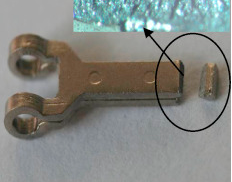
In this study, the fracture failure of the 4Cr13 stainless steel linkage components in circuit breakers was studied. The microstructure and morphology of fracture surface were observed by scanning electron microscopy and optical microscopy. A micro-Vickers tester measured the hardness of the components. The tensile strength and strain of the components were determined by a universal testing machine. The results show that fracture failure mode was quasi-cleavage fracture, and some dimples and edges of cleavage were present on the fracture surface.

Read more