Un industriel expert en corrosion grâce à Procor

2016-10-22_16h02_25

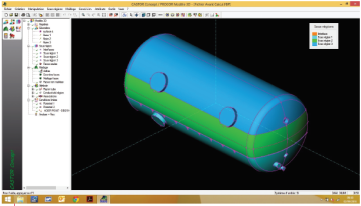
Le logiciel Procor acquis au Cetim par ECT lui permet d’optimiser la protection cathodique de ses filtres et réservoirs. Un atout concurrentiel.

Suite à un stage au Cetim sur la protection cathodique, Fabrice Aniel, le Président d’ECT, décide d’acheter Procor. Ce logiciel a été développé par le Cetim, dans le cadre d’un partenariat de recherche, pour optimiser la protection cathodique des installations métalliques en milieu aqueux.

Lire l’article : ECT – Cetim – Centre technique des industries mécaniques

Grooving corrosion of seam welded oil pipelines

A interesting paper in « Case study in Engineering Failure Analysis«  published on ScienceDirect.com.

24″ pipeline carrying oil was failed in the form of longitudinal crack at the 6 O’clock position resulting in oil spill. The failed pipe was investigated to reveal the main cause of its failure. Cracks were originated from weld defected sites, initiated by grooving corrosion, propagated by inertia at the normal designed pressure condition, and stopped when stress relief is attained.

Read more

Corrosion of Welded Joint in Alloy Steel Pipe

2015-11-15_10h33_54An interesting article published on 4 November 2015 in the International Journal of ELECTROCHEMICAL SCIENCE.

In this paper an investigation on corrosion behaviour of welded joints was performed to facilitate determination the causes of preferential degradation by corrosion of the welded metal (WM) and the heat affected zone (HAZ), in a welded pipeline of grade ASTM A355P5, used in a petrochemical plant as transfer line between a thermal cracking heater and a column which are part of an atmospheric distillation and vacuum (DAV) unit. It was found that the corrosion of the weld analyzed in this research has resulted due to its dendritic structure (pearlite, ferrite, complex carbide, bainite and martensite in localized areas), which reveals the lack of post welding heat treatment (PWHT). Read more …..


Failure analysis of a cracked aluminum 7075 wing internal angle in Airbus A-300

2016-07-05_16h39_20


An article in progress in « Case Studies in Engineering Failure Analysis », Volume 7 (october 2016).


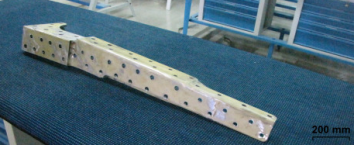
There are 16 angles in Airbus A300s wing box. On the right side, rear spur, and lower flange area of the center wing box, one of these angles had been cracked with a length of 28 mm. This crack has decreased residual strength of the part under allowed values and resulted to a rupture in the rear spur lower cap. Several reports of the same occurrences in other Airbus A300 air crafts, highlight the importance of finding the causes of this failure.  Finally, it was concluded that corrosion fatigue was the main reason which itself comes from manufacturing, maintenance, metallurgical, and geometric reasons as were discussed in this study.

Read more

Perforated mechanism of a water line outlet tee pipe

tuyauAn article published in « Case Studies in Engineering Failure Analysis« , Volume 4, October 2015.

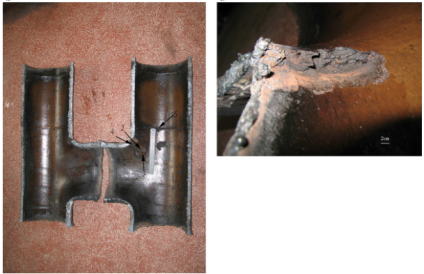
A corroded tee pipe belonging to a 10-in new separator water line outlet installed in an offshore oil well drilling rig was investigated. The configuration of the large corroded pit had the shape of an imperfect horse’s hoof with a completely corroded interior and a honeycomb-like cavity. There is a badly corroded pit at the welded seam at the joint connecting the tee pipe and flange. The penetrating puncture hole at the turn of the tee pipe is likely the result of cavitation erosion accompanied by chemical/electrochemical corrosion, and the corrosion on the seam connecting the tee pipe and flange is likely the result of electrochemical corrosion.

Read more

Stress corrosion cracking of full sized rockbolts

2016-06-04_07h48_16An article published in  « International Journal of Rock Mechanics & Mining Sciences – 81 (2016)« .

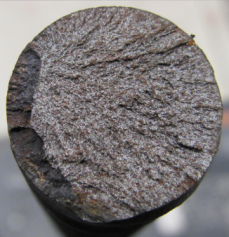
Previous studies had identified that a testing protocol was required to examine stress corrosion cracking (SCC) of full sized rockbolts under simulated in situ conditions. It was found that SSR testing provided an appropriate analogue for examining rockbolt susceptibility to SCC and was thus used to examine the effect of grit blasting, galvanising and varying steel grades on the SCC resilience of rockbolts. Of these, 300 grade steel and galvanising provided the most promising resistance to SSC, while grit blasting provided a 40% improvement in resistance compared to untreated HSAC 840 grade rockbolts.

More

Modes of failure of cemented tungsten carbide tool bits : A study of wear parts

2016-04-18_22h29_00An article published in « International Journal of Refractory Metals and Hard Materials », july 2015.

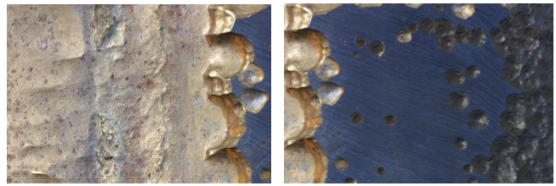
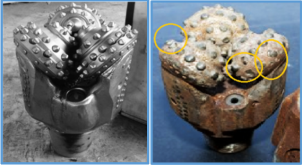
Tungsten carbide alloyed with cobalt (WC/Co) shows unique characteristics like high strength at elevated temperature and high mechanical and chemical resistance that makes carbide tools appropriate for cutting, drilling, mining and machining operation. A whole failure study is revealed within the paper. This study also discusses the failure mode of a tungsten carbide tools, its prediction and remedies.

Read the paper


Testing methodologies for corrosion fatigue on offshore constructions

offshoreA Ghent University Academic Bibliography publication.

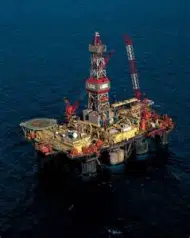
Offshore constructions are subjected to cyclic loading conditions. This situation is combined with the corrosive nature of the surrounding environment. This literature review first introduces the reader to corrosion fatigue. Thereafter a critical comparison of some typical lab-scale fatigue corrosion test setups is given. Special emphasis is devoted to the instrumentation of the setup. This is followed by a design criteria summary which will be used to design a new corrosion fatigue test set-up for evaluating the fatigue properties of steel components in sea water environnent. Read more

Analysis of a Clinically Failed

2015-11-17_08h30_32Un article paru en septembre 2015 dans la revue « Trauma Cases and Reviews » :

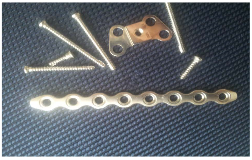
« A reconstructive orthopedic bone plate was submitted for analysis. Traditional failure analysis methods were used to assess the mode of the plate failure. Metallographic investigation of the plate was carried out in this report. Since limited data was available in the literature and clinical data related to subject demography, date of removal as well as reasons for removal unknown, in depth analysis was not possible. However, the plate was received in in-tact condition with minor biological deposits and scratches, it is speculated that the failure of the plate may have been due to biological/clinical reasons, likely infection, rejecting the device due to lack of union at the fracture site. » Lire l’article dans son intégralité …


Failure analysis of a motor-car coil spring

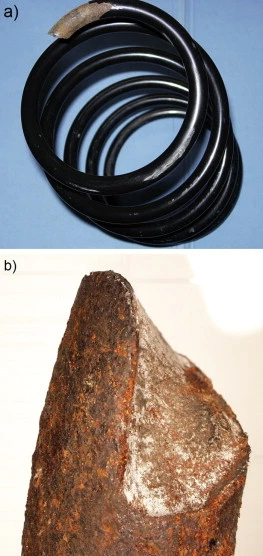
An interesting case study of failure analysis of a motor-car coil spring broken was published in Case Studies in Engineering Failure Analysis on December 2013. A damage of protective layer was the reason for corrosion occurrence. A combination of corrosion and fatigue caused the failure of the spring.

Read more