Failure Analysis – Industrial Case Studies

This web site deals with industrially-derived case studies in forensic engineering and failure analysis, which are firmly grounded in the context of their legal, insurance and design consequences. The development of this interactive learning package follows on from existing web-based projects in learning support via on-line tutorials, focussed internet resources and detailed analysis and discussion of case studies in failure.

More at : Failure Analysis – Industrial Case Studies.

Analysis of internal corrosion in subsea oil pipeline

A new interesting article in « Case Studies in Engineering Failure Analysis ».

Failure of a subsea crude oil API 5L X52 steel pipeline which led to oil leakage has been reported to occur after 27 years in service. Some leaks were found to form at the bottom of the horizontal API 5L X52 steel pipeline near an elbow section which connected the pipeline to a riser. The article present investigations to analyze the main cause of failure

More at : Analysis of internal corrosion in subsea oil pipeline.

Analyse d’assemblages composites laminés boulonnés

Bolted joint

Voici une étude publiée dans  » IOSR Journal of Engineering (IOSRJEN)” en décembre 2013.

Les fixations mécaniques sont une méthode commune pour assembler les matériaux composites. Dans l’aéronautique les jonctions mécaniques sont caractérisées par des tolérances serrées tant au niveau des systèmes d’attaches que des trous usinés. Le travail qui fait l’objet de cette publication propose une modélisation d’une jonction simple. Diverses sollicitations sont évaluées théoriquement et comparées analytiquement pour de l’acier doux et de la fibre de verre.

telecharger le doc

Failure analysis of a bridge crane shaft

Failure analysis of a shaft used in a bridge crane has been carried out. The shaft was fractured in the keyway with evidence of fatigue.

This paper published in  » Engineering Failure Analysis » was finded on ScienceDirect.com.

Read the article : click here

Usure des compresseurs alternatifs

Cet article reprend une présentation faite au 22nd International Congress of Mechanical Engineering (COBEM 2013) en Novembre 2013, à Ribeirão Preto, SP, Brésil

Les réfrigérants utilisés dans les compresseurs de vapeur ont des propriétés thermodynamiques spécifiques  qui sont décisives pour la performance du système. Montréal et les protocoles de Kyoto ont amorcé une discussion sur les réfrigérants alternatifs, qui mènent à de nouvelles exigences pour les compresseurs.

L’objectif de ce papier est de comparer les tests d’usure accélérée des compresseurs hermétiques, en se concentrant sur les l’usure des composants mécaniques. Plusieurs méthodologies de test sont discutées ainsi que les procédures utilisées pour la quantification de l’usure.

Rupture brutale d’une articulation de coupleur de wagon ferroviaire

Un article intéressant paru dans « Engineering Failure Analysis »  et publié en ligne sur  ScienceDirect.com.

Ce document relate les investigations menées pour déterminer les causes de rupture brutale fragile d’une articulation en acier moulé de coupleur de wagon ferroviaire.

Pour lire l’article cliquez ici

Failure of rubber O-ring

A new interesting paper in  » Engineering Failure Analysis » published on ScienceDirect.com.

This paper presents the effects of hydrogen pressure, ambient temperature and pressure cycle pattern on fracture behavior of O-rings moulded from a peroxide-crosslinked EPDM rubber with white reinforcing filler under cyclic exposure to high-pressure hydrogen gas.

Read more at : Failure behavior of rubber O-ring under cyclic exposure to high-pressure hydrogen gas


Failure of a Motor Vessel’s Crankshaft 1968

An interesting paper published in  « Engineering Failure Analysis » :

In July 1968 the Swedish motor vessel “MV Stureholm” traveled from Sweden across the North Atlantic with destination to the American gulf harbours.  About 100 nautical miles north of the peninsula Yucatan the 9,000 HP diesel engine failed as a consequence of fatigue failure of the crankshaft. The ship was disabled and had to be towed to Veracruz, Mexico. The Swedish shipowning company decided to perform a temporary repair in Veracruz by welding the fatigue crack. Back in Sweden the damaged but repaired crankshaft was dismounted from the engine and inspected by surveyors. The result was that a fatigue crack had initiated from a subsurface solidification (hot) crack.

This paper brings out the detail of investigation carried out. Read more at : Failure of a Motor Vessel’s Crankshaft 1968.

Premature cracking of dies for aluminum alloy die casting

Die casting AluminiumAn interesting paper of Bogdan Pawlowski, AGH University of Science and Technologie in Krakow, published in « Archives of Metallurgy and Materials » :

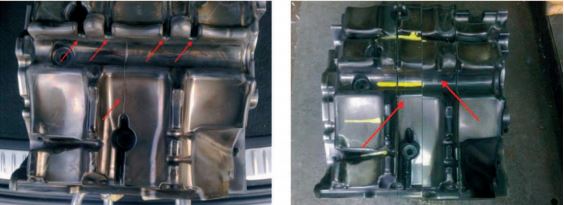
Two identical dies for aluminum alloy die-casting failed prematurely because of a number of parallel cracks on the working surface. These cracks were of a mechanical nature related to incorrect microstructural banding orientation of the die core and related to improper heat treatment. The root cause of premature cracking of dies was improper heat treatment (temper embrittlement).

More at :  http://imim.pl/files/archiwum/Vol4_2013/40.pdf

Stress Distributions in a Single-lap Adhesively Bonded Joint

A new interesting paper in « International Journal of Adhesion and Adhesives«  published on ScienceDirect.com.

Increasing applications of adhesively bonded joints require understanding of the stress distribution along the bond-line and the stresses that are responsible for the joint failure. The effect of boundary conditions on the actual stress distributions of a single-lap adhesively bonded joint was investigated using the three dimensional finite element method. This paper brings out the detail of investigation carried out.

More at : Influence of Boundary Conditions on Stress Distributions in a Single-lap Adhesively Bonded Joint.