Fatigue Failure Analysis of a Cooling Fan Blade

A paper published in  » Engineering Failure Analysis » on www.sciencedirect.com.

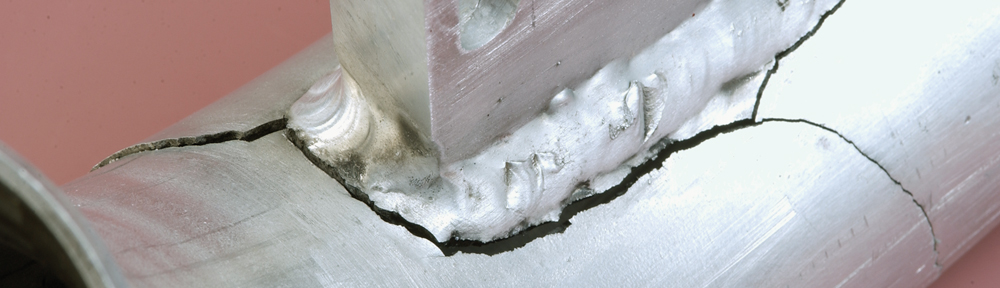
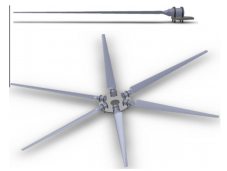
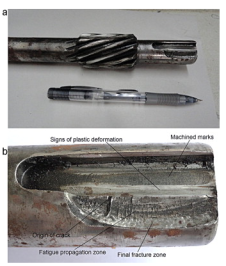
Fatigue failure of holding U-bolt of a cooling fan blade is analyzed. Fractography of the fracture surface reveals the characteristics of a fatigue fracture. Finite element modeling is used for stress analyzing. Analysis of the loading conditions indicates that the bolts are under multiaxial fatigue. ……..

Read more

Multiscale fracture of cellular materials

A paper published in « International Journal of Terraspace Science and Engineering« , 2016.

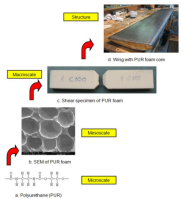
This paper presents a review of mode I fracture toughness obtained by authors from micromechanical modeling and fracture toughness test……… The mode I fracture toughness was determine using three different specimens (Single Edge Notch Bending, Single Edge Crack and Asymmetric Semi Circular Bending). Different Polyurethane foam densities were investigated. Finally, a good correlation between analytical, numerical and experimental fracture toughness results was obtained.

Read more

Ruptures d’arbres épaulés clavetés (3)

Avatar Cas ConcretsUn précédent article «Vintage» faisait état d’une règle pratique de positionnement établie au Cetim en 1977. Quatre fiches « Cas Concrets » illustraient cet publication. Cinq autres fiches sont venus précédemment compléter cet article.

Voici les trois dernières fiches «Cas Concrets» d’arbres épaulés clavetés rompus en fatigue. Elles avaient été publiées dans le numéro 55 d’avril 1978 de Cetim-Informations.

telecharger le doc


Vintage – Règle pratique du positionnement des rainures de clavetage

Vintage Clavettes_arbres_epaulesRetrouver dans la Mécatech, du Cetim, dans la série « Vintage », un article sur le bon positionnement des rainures de clavette sur les arbres épaulés clavetés. Il est illustré de nombreux « Cas Concrets ».

Les différents articles de cette série «Vintage» ont été publiés dans la revue Cetim Informations dans les années 74 à 90. Bien qu’ils soient anciens, le contenu de ces articles est toujours d’actualité… Ils viennent en complément de la série «Cas concrets» consacrée à des fiches d’analyses de défaillances.

Failure analysis of a bridge crane shaft

A paper published in « Case Studies in Engineering Failure Analysis » on april 2014.

Failure analysis of a shaft used in a bridge crane has been carried out. The shaft fractured in the keyway with evidence of fatigue. The geometry of the keyway also promoted the initiation crack because the width and height were erroneously designed. It was concluded that all these factors produced fatigue failure.

Read more

Brittle fracture of a grade E cast steel knuckle

This paper was published in « Case Studies in Engineering Failure Analysis » on April 2014. It investigated the brittle fracture mechanism of a grade E cast steel knuckle that is one of the key components of the coupler for railway wagon.

As a result, it can be inferred that under an impact load that did not exceed material fracture limit, the micro-cracks initiated from weld repair zone propagated rapidly into the inner matrix by continuously fracturing the dendrites along shrinkage porosity regions until the knuckle failed instantly.

Read more.

Analysis of abnormal fatigue failure of forklift forks

A paper published in  » Engineering Failure Analysis » finded on ScienceDirect.com.

The analysis of an abnormal failure of forklift forks is presented in this work. The investigation results suggested that failure occurred due to fatigue mechanism followed by sudden overload fracture. The orientation of fatigue fracture indicates abnormal lifting operation, favouring crack initiation from outer fork area which is the compression designed zone. Moreover, various surface flaws and weakness areas (such as surface marks, decarburized microstructures and weld zones) identified on the outer fork zone, compromise fatigue strength inducing premature crack nucleation and fast growth towards final failure.

Read the article : click here

Etude des ruptures de vis pédiculaires en Ti6Al4V

Un article intéressant paru dans « Engineering Failure Analysis« , Octobre 2012 concernant l’analyse de la  défaillance de dix vis pédiculaires en Ti6Al4V explantées de 5 patients qui ont eu une rupture dans les 5 ans après implantation.

Les vis pédiculaires sont couramment utilisées pour améliorer l’immobilisation de la colonne vertébrale dans le traitement de plusieurs maladies du rachis. Cependant, les taux de fractures de vis sont encore élevés de nos jours. Les efforts visant à assurer la conception et le choix des matériaux doit être encouragés. 

La fatigue sous sollicitations de flexion a été le principal mécanisme responsable des ruptures. Les fractures ont eu lieu près du filetage d’extrémité ou au niveau du filetage intermédiaire. Dans certains cas, de la corrosion sous tension a été associée à l’initiation de la rupture. La microstructure lamellaire ou en plaque, le faible rayon du fond de filet et la rugosité de surface ont été des facteurs impliqués dans ces défaillances.

Lire plus

4 Cas Concrets de ruptures

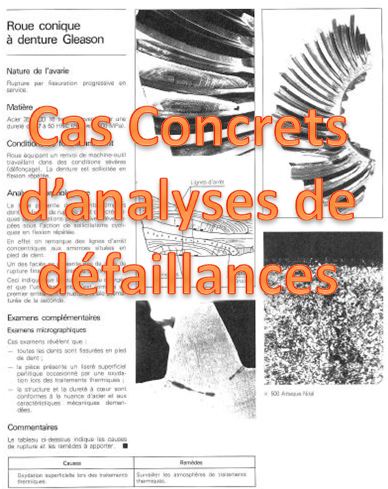
Avatar Cas ConcretsQuatre cas d’analyses de défaillances par ruptures survenues sur des organes de machines de divers horizons : un tirant de palier, un arbre de roue, un corps de piston et un corps d’amortisseur de tampon de wagon ferroviaire.

Ces quatre fiches d’analyse de défaillances avaient été publiées en avril 1987 dans le numéro 100 de la revue Cetim-information. Elles sont toujours d’actualité.

Lire plus 

Fatigue fracture of cutter blade made of high-speed steel

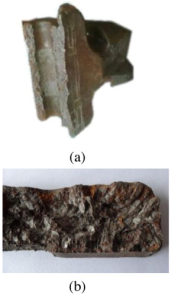
An interesting  paper in « Case study in Engineering Failure Analysis » published on ScienceDirect.com. This paper presents the failure analysis of broken blade of the cutter Ku 500VX. The damage of the blade was caused by changes of the structure (formation of the brittle micro dendritic structure) that occurred during manual electric engraving process when the material was heated till its melting point. As a results the stresses occurred in surface what provided to micro cracking and to propagate the fatigue fracture. The origin of this fatigue fracture was in the place where the inscription was made.

Acceder article