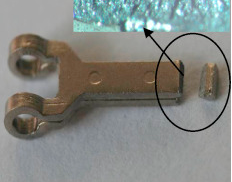
Failure analysis of 4Cr13 stainless steel linkages in circuit breakers

2016-09-06_15h47_58A case study published in « Case Studies in Engineering Failure Analysis » – April 2016.

In this study, the fracture failure of the 4Cr13 stainless steel linkage components in circuit breakers was studied. The microstructure and morphology of fracture surface were observed by scanning electron microscopy and optical microscopy. A micro-Vickers tester measured the hardness of the components. The tensile strength and strain of the components were determined by a universal testing machine. The results show that fracture failure mode was quasi-cleavage fracture, and some dimples and edges of cleavage were present on the fracture surface.
Read more

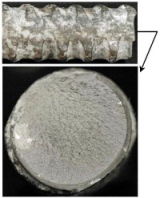
Effect analysis of an arc-strike-induced defect on the failure of a post-tensioned threadbar

2016-09-06_15h41_49

An article about a case study published in « Case Studies in Engineering Failure Analysis » – april 2016.

A temporary threadbar used for precast segmental construction broke during the post-tensioning stage before reaching the service load. Failure analysis showed that the premature failure of the bar was due to the presence of an arc strike. The arc strike effects on the material and threadbar integrity are considered.

Read more

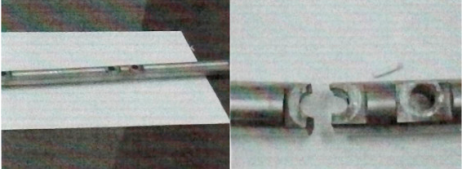
Analysis of a failed rocker arm shaft of a passenger car engine

2016-09-06_14h16_17

A case study published in « Case Studies in Engineering Failure Analysis » – april 2016.

This paper investigates the failure of a rocker arm shaft of a passenger car. The shaft failed by brittle fracture across one of the four holes supporting the shaft into the cylinder head. The running distance of the engine just before failure was 40,626 km. These cracks may have been induced in the shaft by the non-uniform cooling during quenching in the course of heat treatment, or may be nucleated by repeated loading during service. This premature failure has occurred by the rapid crack propagation because of the lower fracture toughness of the martensite.

Read more

Case study of severe strip breakage in rolling mill

2016-08-30_12h43_54A case study published in « Case Studies in Engineering Failure Analysis » – april 2016.

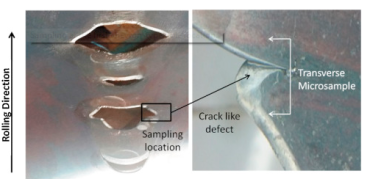
In this paper, a case of severe strip breakage in rolling mill of Thin Slab Casting and Rolling (TSCR) shop of TATA Steel, Jamshedpur is presented. Visual observation revealed complete splitting with material missing along the central axis of the strip. Presence of defects in form of white stringers, white patches and holes were observed along the same axis just ahead of split location.

Read more

Failure analysis of tube-to-tubesheet welded joints in a shell-tube heat exchanger


An article in progress in « Case Studies in Engineering Failure Analysis », Volume 7 (october 2016).

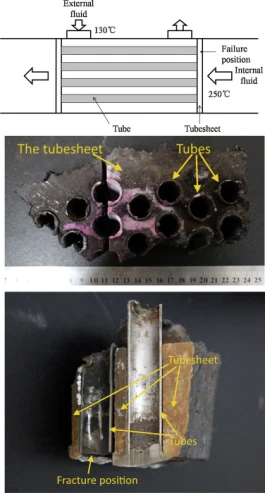
In this work, fracture failure of a shell-tube heat exchanger at the tube-to-tubesheet welded joints was investigated. Fatigue started at initial defects of the welded joint was confirmed as the failure mechanism of the heat exchanger. Bad welding and unsuitable expansion gave rise to the formation of initial cracks. The alternating stress comes from various reasons such as the resonant vibration.

Read more

Failure analysis of a diesel generator connecting rod

2016-07-05_16h55_33

An article in progress in « Case Studies in Engineering Failure Analysis », Volume 7 (october 2016).


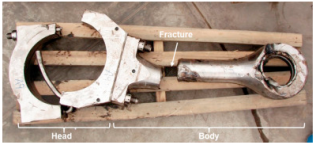
This paper presents the results of a failure analysis investigation conducted in a connecting rod from a diesel engine (18 V, four-stroke) used in the generation of electrical energy. The continuous output of the engine was 10.5 MW, at 600 rpm ; before the failure of the con-rod it accumulated 35836 service hours, working with a load factor of 80%.

Read more

Failure analysis of a half-shaft of a formula SAE racing car

2016-07-05_16h47_58An article in progress in « Case Studies in Engineering Failure Analysis », Volume 7 (october 2016).

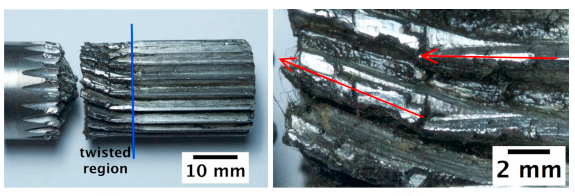
The formula SAE is a competition among students worldwide, where they are challenged to design, build and test a small formula-type racing car, following rules and specifications defined by the Society of Automotive Engineers (SAE). In the present analysis, a premature failure of a half-shaft of the transmission system of a racing car occurred after circa 100 km of use. The results show that the alloy steel bar used for the half-shaft did not follow specifications, with a consequent lower strength and resulting in a material with insufficient loading capacity and fatigue resistance. As a consequence, the fracture process was a confluence of torsional fatigue crack propagation and overload ductile fracture through the spline section of the half-shaft.

Read more

Failure analysis of a cracked aluminum 7075 wing internal angle in Airbus A-300

2016-07-05_16h39_20


An article in progress in « Case Studies in Engineering Failure Analysis », Volume 7 (october 2016).


There are 16 angles in Airbus A300s wing box. On the right side, rear spur, and lower flange area of the center wing box, one of these angles had been cracked with a length of 28 mm. This crack has decreased residual strength of the part under allowed values and resulted to a rupture in the rear spur lower cap. Several reports of the same occurrences in other Airbus A300 air crafts, highlight the importance of finding the causes of this failure.  Finally, it was concluded that corrosion fatigue was the main reason which itself comes from manufacturing, maintenance, metallurgical, and geometric reasons as were discussed in this study.

Read more

Root cause analysis (RCA) of fractured ASTM A53 carbon steel pipe at oil & gas company

2016-07-05_16h25_54

An article in progress in « Case Studies in Engineering Failure Analysis », Volume 7 (october 2016).


Incident involving failures of ASTM A53 carbon steel pipe, connected to pressure safety valve and carrying raw gas has caused serious supply disruption. This study was performed to identify the most probable cause of the pipe failure.

Read more

Perforated mechanism of a water line outlet tee pipe

tuyauAn article published in « Case Studies in Engineering Failure Analysis« , Volume 4, October 2015.

A corroded tee pipe belonging to a 10-in new separator water line outlet installed in an offshore oil well drilling rig was investigated. The configuration of the large corroded pit had the shape of an imperfect horse’s hoof with a completely corroded interior and a honeycomb-like cavity. There is a badly corroded pit at the welded seam at the joint connecting the tee pipe and flange. The penetrating puncture hole at the turn of the tee pipe is likely the result of cavitation erosion accompanied by chemical/electrochemical corrosion, and the corrosion on the seam connecting the tee pipe and flange is likely the result of electrochemical corrosion.

Read more