Failure analysis of edge discoloration of galvanized fuel tank

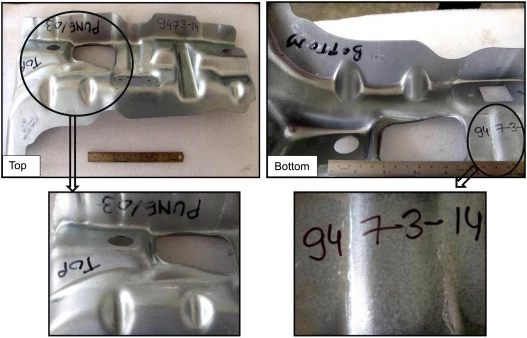
An interesting case study of failure analysis of defect on the surface of some galvanized fuel tank will be published on October 2015 in Case Studies in Engineering Failure Analysis 

A peculiar type of edge discoloration defect on the surface of some galvanized fuel tank was observed, causing significant appearance problems. In the study, the surface defect was characterized by visual inspection, optical microscopy, scanning electron microscopy and energy dispersive spectroscopic analysis to understand the source and mechanism of the defect. The paper presents the results of the investigation.
Read more

Failure analysis of a motor-car coil spring

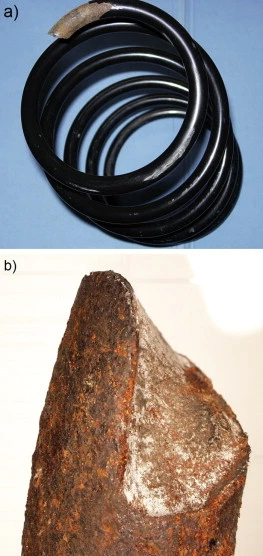
An interesting case study of failure analysis of a motor-car coil spring broken was published in Case Studies in Engineering Failure Analysis on December 2013. A damage of protective layer was the reason for corrosion occurrence. A combination of corrosion and fatigue caused the failure of the spring.

Read more

A failure analysis study on the fractured connecting bolts of a filter press

An interesting case study of failure analysis will be published in Case Studies in Engineering Failure Analysis in October 2015

The purpose of this study was to investigate the main causes of the co-fracture of sixteen connecting bolts of a filter press cylinder–piston system. Stress state of the bolts during the service conditions has been analyzed and the failure reasons were determined from the fractography analysis and gathered information. According to the obtained results, it was concluded that the bolts had failed by the fatigue mechanism. It seems that insufficient torque was used during assembly.

Read more at : A failure analysis study on the fractured connecting bolts of a filter press

Failure Analysis of a Polymer Centrifugal Impeller

An other new case study of failure analysis had been published in october 2015 in Case Studies in Engineering Failure Analysis.

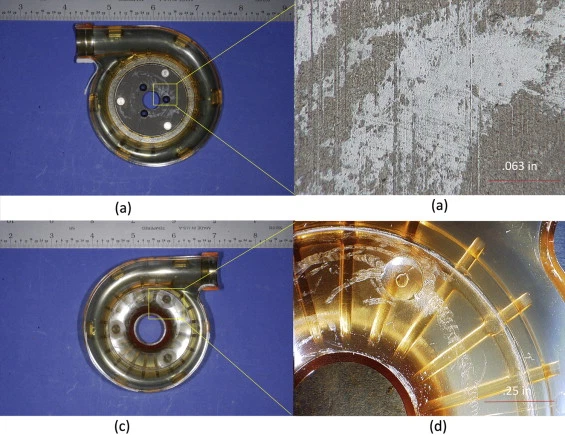
A failure analysis investigation was performed on a fractured polymer impeller used in a respiratory blower. A radial split down the impeller center was observed, with symmetric fracture faces about the impeller bore. The brittle fracture morphology and defects within the impeller bore suggest that premature failure occurred because of multiple interacting factors including: intermittently high centrifugal velocities, imbalance bore and shaft conditions, defects within the bore caused by machining, and stress concentrations along the circumference of the impeller lip.

Read more at : Failure Analysis of a Polymer Centrifugal Impeller.

Leg Weld Fatigue Cracks in Anhydrous Ammonia Nurse Tanks

A new case study of failure analysis was published on  Case Studies in Engineering Failure Analysis, april 2015

In an accident in southwest Iowa, USA in 2012, an anhydrous ammonia nurse tank vented its entire cargo of 5500 liters (1500 gallons) of liquid ammonia to the atmosphere. Follow-up study of the failed tank revealed a through-crack along a weld used to connect the tank to its running gear. The authors recommend that side-angle ultrasound be considered for use in periodic nurse tank inspections.

via Leg Weld Fatigue Cracks in Anhydrous Ammonia Nurse Tanks.

Coeur Carmat : on en sait plus sur les premiers hommes implantés

Les informations concernant les premiers malades ayant reçu un cœur artificiel Carmat étaient jusqu’à présent distillées au compte-gouttes. Grâce à la publication mercredi 29/07/2015 dans The Lancet d’un article émanant du Pr Alain Carpentier – le chirurgien cardiaque concepteur de ce cœur artificiel – et de ses collègues de l’hôpital européen Georges-Pompidou à Paris ainsi que du CHU de Nantes, on en sait un peu plus sur les deux premiers malades. « L’analyse des deux dispositifs n’a révélé aucune défaillance mécanique et les sources d’éléments électroniques défectueux ont été trouvées et corrigées dans les procédures de fabrication ultérieures », peut-on lire.
Lire l’article du Point du 30/07/2015.

Failure Analysis of a Polymer Centrifugal Impeller

A new case study published in Case Studies in Engineering Failure Analysis and posted on Sciencedirect.com.

The failure analysis investigation was performed on a fractured polymer impeller used in a respiratory blower. The brittle fracture morphology and defects within the impeller bore suggest that premature failure occurred because of multiple interacting factors including: intermittently high centrifugal velocities, imbalance bore and shaft conditions, defects within the bore caused by machining, and stress concentrations along the circumference of the impeller lip.

more at : Failure Analysis of a Polymer Centrifugal Impeller.

Rupture d’une roue conique d’un moteur d’hélicoptère

The Transportation Safety Board of Canada a publié sur son site les résultats de l’enquête menée à la suite de l’accident d’un hélicoptère Aerospatiale AS 350 B3.

L’examen du moteur a permis de déterminer que la roue conique à 41 dents (référence 0292127330) s’était brisée à cause d’une fissuration de fatigue polycyclique. La roue avait été posée au moment de la fabrication du moteur, et elle totalisait 1644 heures de vol depuis sa mise en service initiale. L’examen métallurgique de la roue a révélé nombre de criques de fatigue prenant naissance à la base de nombreuses dents. Des criques de fatigue circulaires ont également été découvertes en bordure de la roue. Celle-ci ne présentait aucun défaut de fabrication qui aurait pu véritablement contribuer à sa défaillance.

Lien vers le rapport d’expertise :Transportation Safety Board of Canada – Aviation Investigation Report A07O0314.

Rupture d’un ressort de suspension de voiture

Un cas concret d’analyse de défaillance rapporté par ScienceDirect.com et publié dans « Case study in Engineering Failure Analysis ».

Un dommage du revêtement anti-corrosion associé à un processus de fatigue est responsable de cette défaillance.

Pour lire l’article cliquez ici

Premature Failure of Dissimilar Metal Weld Joint at Intermediate Temperature Superheater Tube

A new case study on Sciencdirect.com. This article was published in « Case Studies in Engineering Failure Analysis » of april 2015.

Premature Failure of EPRI recommended nickel based filler for Dissimilar Metal welds (DMW) such as in the present study has been investigated to determine the root causes. The mechanism involved a creep stage I process on the alloy steel side due to improper PWHT leading to undesirable carbides precipitation increasing the hardness. Therefore, the sensitivity of the welding to micro-cracking combined to bending stresses involvement induced a premature failure within short time of operation.

Read more at : Premature Failure of Dissimilar Metal Weld Joint