Failure Analysis of HDPE Pipe for Drinking Water Distribution and Transmission

Un article paru dans la revue « Design and Modeling of Mechanical Systems » de mars 2015.

« Pipes and elbows are important components in any piping systems for transportation of water. These structures are subjected to complex loads taking into account their geometrical configuration and the multiplicity of the loading conditions in service. The origin of failure of these mechanical components is directly related to the presence of defects. The principal objective of this work is to analyze the severity of defects on high density poly-ethylene pipe widely used for water piping networks. »
Voir l’article


Shape Fastener of the Bus Skeleton Testing

fasternerA paper presented at « International Conference on Electromechanical Control Technology and Transportation » (ICECTT 2015).

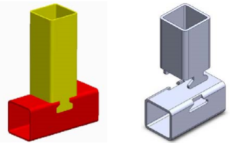
The paper deals with the bending tests of new designed joints for bus skeletons. The frames of buses have to satisfy various demands, but the safety of the passengers is the priority. The actual welded joints should be replaced by new type of profiles connections in the future. Finite elements method was used for the bending test simulation and for the stress investigation; the real experiments were done using the universal test equipment ZD10/90. Obtained results are comparable, so authors aim to realize next experiments in next days at which other shapes of the joints will be tested. Read more

Failure Analysis: Case Study Challenger SRB Field Joint

challenger85An article which will be published in International Journal of Engineering and Technology, Vol. 8, No. 6, December 2016.

The Challenger Solid Rocket Boosters (SRB) Field Joint initial design was deemed as a direct cause of the shuttles catastrophic failure during lift off.  The Field Joint SRB was a key component in containing dangerous gases produced in the SRB.  After conducting research on the Challenger accident, a Fault Tree Analysis was developed to analyze the reliability of the SRB field joint configuration in relation to its goals.  The reliability model will show how the field joint fell short in terms of operational reliability.   Read more at.

Analysis of a Clinically Failed

2015-11-17_08h30_32Un article paru en septembre 2015 dans la revue « Trauma Cases and Reviews » :

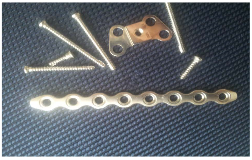
« A reconstructive orthopedic bone plate was submitted for analysis. Traditional failure analysis methods were used to assess the mode of the plate failure. Metallographic investigation of the plate was carried out in this report. Since limited data was available in the literature and clinical data related to subject demography, date of removal as well as reasons for removal unknown, in depth analysis was not possible. However, the plate was received in in-tact condition with minor biological deposits and scratches, it is speculated that the failure of the plate may have been due to biological/clinical reasons, likely infection, rejecting the device due to lack of union at the fracture site. » Lire l’article dans son intégralité …


Défaillance des assemblages vissés, soudés, rivetés ou collés

A la suite de la défaillance d’un assemblage, vous avez besoin d’un expert pour :

–  comprendre les raisons de défaillance de vos assemblages collés, vissés, soudés, rivetés.

–  expliquer de façon objective les raisons des désordres apparus.

–  rebondir sur les constats et mettre en ouvre les solutions correctives et pérennes.

En confiant votre expertise au Cetim, centre technique indépendant et neutre, vous êtes assuré d’une approche objective, compétente et factuelle.
Ses équipes dédiées pratiquent l’analyse des défaillances au quotidien depuis  40 ans et s’engagent sur des diagnostics.

Acceder article

Cracked Speed Boat Steering Wheel

2015-10-19_13h53_57A Case study published in « Case Studies in Engineering Failures Analysis » of october 2015.

Failure of a cracked steering wheel is studied in this paper. Steering wheel, mounted on a speed boat, had cracks emanating from one of the fastener holes until final fracture occurred.Possible causes of crack occurrence include excessive fastener torque moment, fretting between fastener and hole combined with poor machining that left marks that serve as potential crack initiation points. Obtained results are valuable for predicting fracture behavior of the cracked steering wheel and can be taken as a reference for design and exploitation process of such component.

Read more

Wire breakage of Tyre bead grade

2015-10-18_11h50_39A new case study in « Case Studies in Engineering Failure Analysis » of October 2015.

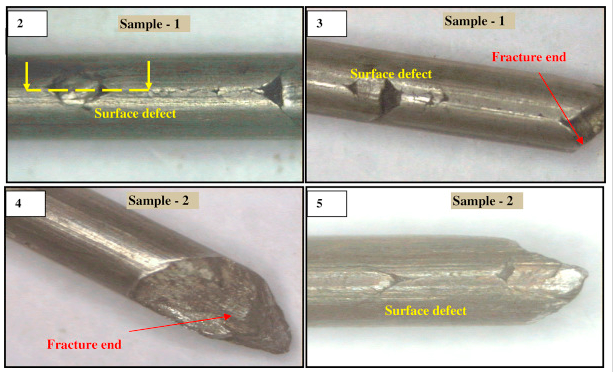
Tyre bead grade wire is used for tyre making application. The wire is used as reinforcement inside the polymer of tyre. The wire is available in different size/section such as 1.6 mm to 0.80 mm thin Cu coated wire. During tyre making operation at tyre Manufacturer Company, wire failed frequently. In this present study, different broken/defective wire samples were collected from Wire Mill for details investigation of the defect. The analysis revealed that, white layer of surface martensite was formed and it was caused the final breakage of wire. In this study they have also discussed about the possible reason for the formation of such kind of surface martensite (hard-phase).

Read more

Failure analysis of a leaked oil pipeline

2015-10-18_11h39_48A new paper in « Case Studies in Engineering Failure Analysis« .

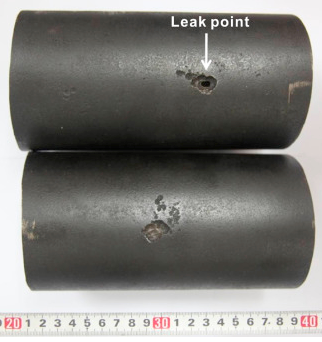
An oil pipeline embedded in an underground trench had failed. Through the accident investigation they found that there was a perforation at the leak point of the pipeline. After careful analysis it is concluded that the leakage of the pipeline was mainly caused by the liquid impingement erosion.

Click here to read more

Nouveau robot portatif pour l’évaluation des contraintes résiduelles des pièces métalliques

Le Cetim présent sur Enova 2015 a présenté pour la première fois le X-Raybot, un robot portatif dédié à l’évaluation des contraintes résiduelles des pièces métalliques par diffraction de rayons X, codéveloppés avec la société MRX.

Lire l’article paru dans « Contrôles-Essais-Mesures »

Failure analysis of a Ti-6Al-4V ultrasonic horn used in cavitation erosion tests

MekanicaA paper published in MECHANIKA. 2015 Volume 21(4): 272–276.

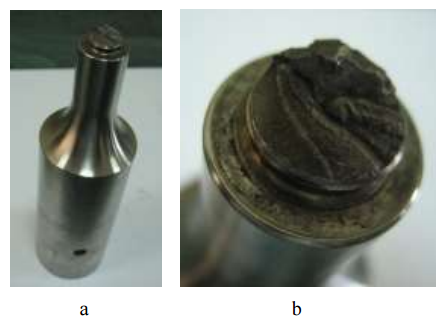
During the testing of the materials’ cavitation erosion resistance on vibratory systems by direct method (ASTM G32), the thread from the ultrasonic horn – test specimen connection, is subjected to fatigue. Operational experience has shown the occurrence of cracks and fractures in this area after a number of stress cycles that was lower than anticipated. The paper presents an analysis applied on four types of ultrasonic horns geometries: the original geometry with an external thread M12 and three modified geometries, with an internal thread M10 and M8. The four geometries were subjected to static analysis in order to determine the stress distribution. Based on static analysis, the behavior of the horns to fatigue was simulated and analyzed, determining the fatigue life, safety factors and optimal geometry.

Read more