

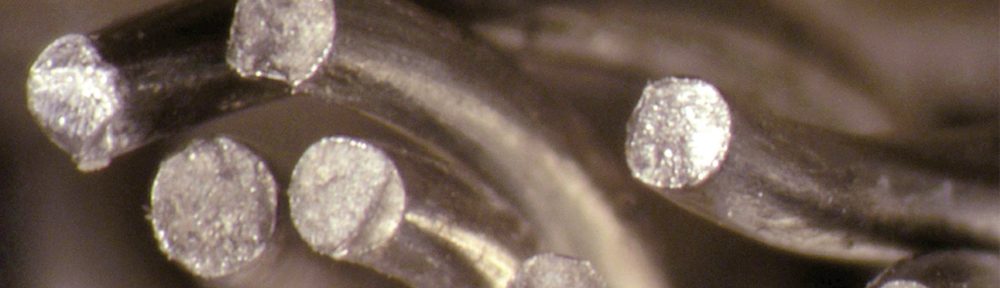
 In this review paper, a methodology for measuring the interface fracture toughness of a crack between two isotropic, homogeneous materials and a delamination between two laminae of unidirectional composite materials of differing directions is presented. Four cases are considered. For the laminates described here, they were determined by the Stroh and Lekhnittski formalisms. A failure criterion determined from first principles is presented.
 This article documents the metallurgical evaluation of a rolling element bearing that failed due to electrical discharge damage. This rolling element bearing was used in a helicopter turbine engine that failed in-flight, resulting in a hard landing of the helicopter. Optical and electron microscopy as well as energy dispersive spectroscopy were used to evaluate the bearing. Pitting and material transfer on the external bearing races bearing and mating surfaces revealed that the electrical discharge damage occurred while the engine’s components were not rotating.
 Cet ouvrage de la collection Performances du Cetim «Comportement en fatigue des matériaux métalliques – Fatigue des assemblages soudés – Soudage à l’arc» est le deuxième fascicule de la collection. Dédié spécifiquement à la fatigue des assemblages soudés, il traite notamment de la conception de ces assemblages, de leur optimisation et des moyens pour calculer leur résistance.Les bonnes pratiques de conception des assemblages soudés, le choix de l’acier et un classement de ces assemblages en fonction de leurs contraintes admissibles sont données en annexe.
Pour en savoir plus : clic ici
 A new paper in « Case study in Engineering Failure Analysis » published on ScienceDirect.com.
The failure analysis of an insert ring of a burner in a 156 MW gas turbine, made of 20Cr32Ni1Nb alloy is presented. Normally, the useful service life of these parts under ideal conditions is about 30000 hours. However, more likely fracture and failure could be observed in5000-hour inspections, which resulted in the early and premature replacement of these parts. This paper brings out the detail of investigation carried out.

 A new paper in « Case study in Engineering Failure Analysis » published on ScienceDirect.com.
This paper describes cracking of turret terminals made of free cutting brass during swaging operation. The crack propagation tendency during cold working of brass turret terminals made from different compositions is studied through optical and scanning electron microscopy. Finally, composition for obtaining crack free terminals during swaging is suggested for applications involving cold swaging.

 A Thesis work of Högskolan Dalarna, Falun, Sweden online on http://www.diva-portal.org/.
This work has had the purpose to examine defects and the cause of crack growth during long termstorage in rolled bars. The bars in question are rolled and stored at Ovako in Hofors. The problem is approached by theoretically examining the possibilities of hydrogen damage, room temperature creep and naturally occurring porosity.


A interesting paper in « Case study in Engineering Failure Analysis » published on ScienceDirect.com.
Circular penetrable cracks occurred at the converge region of upward acid media (H2S and HCOOH) in the opposite position of traverse vapor ingress pipe of the lower part of the upper sealing head of the deaerator/sourgas stripper during the operation of the deaerator/sourgas stripper of the ammonia unit in a chemical fertilizer plant.

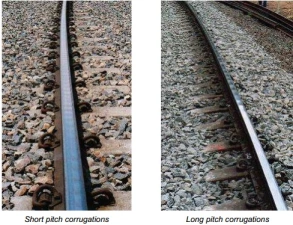 An other publication of the Asset Standards Authority (ASA), an independent unit established within Transport for NSW of Australia.
This manual provides guidelines for the identification of rail surface defects during track inspections. The manual is part of RailCorp’s engineering standards and procedures publications. More specifically, it is part of the Civil Engineering suite that comprises standards, installation and maintenance manuals and specifications. Manuals contain requirements, process and guidelines for the management of civil assets and for carrying out examination, construction, installation and maintenance activities.
 An other interesting publication of the Asset Standards Authority (ASA), an independent unit established within Transport for NSW of Australia.
This manual provides requirements, processes and guidelines for the testing of rail for internal defects and for the acceptance testing of rail welds and weld repairs. The manual is part of RailCorp’s engineering standards and procedures publications. More specifically, it is part of the Civil Engineering suite that comprises standards, installation and maintenance manuals and specifications. Manuals contain requirements, process and guidelines for the management of track assets and for carrying out examination, construction, installation and maintenance activities.
