Failure analysis on unexpected wall thinning of heat-exchange tubes in ammonia evaporators

ScienceDirect.com publishes a new « Case Studies in Engineering Failure Analysis« .

A failure incident of heat-exchange tubes in ammonia evaporators, which suffered from unexpected wall thinning after only one-year service with respect to their original design lifetime of fifteen years, was reported and carefully analyzed. The analysis results demonstrated that the unexpected wall thinning of tubes was primarily ascribed to multiple corrosion factors including uniform corrosion, pitting and interaction behavior between them. Relative failure mechanisms were discussed in detail and prevention measures were also proposed for ammonia evaporators under similar operating condition.

touche Read more

Influence of Weld Defects on the Fatigue Resistance of Thick Steel Plates

Conférence présentée par P. Schaumann et M. Collmann du ForWind-Center for Wind Energy Research, Institute for Steel Construction, 30167 Hannover, lors de la 5th Fatigue Design Conference, Fatigue Design 2013 qui s’est tenue en novembre 2013 au Cetim à Senlis.

Abstract : Multi-wire submerged arc welding (SAW) process is conventionally used for long welds with large cross sections in tubular steel tower manufacturing. By applying non-vacuum electron beam welding (NVEBW), the number of passes and the heat input can be notably reduced. For plate thicknesses of 20 mm or more the continuous appearance of solidification cracks inside the weld cross section rouse a great challenge. The fatigue resistance is reduced significantly and the safety of the component cannot be ensured. In this paper analytical and experimental investigations are discussed for predicting fatigue life of defective welds.

telecharger le doc

Corrosion et Prévention de la Corrosion : Introduction à la Corrosion

L’aluminium est par nature un matériau fortement réactif. Mais il forme rapidement une couche mince et dense d’oxyde qui protège très bien le matériau sous-jacent. La présence de la couche d’oxyde rend l’aluminium très intéressant pour de nombreuses applications.

Cependant, dans certains environnements l’aluminium peut être sensible à la corrosion. Dans cette section du site aluMATTER sont expliqués en détail les principes de corrosion de l’aluminium et les techniques de traitement de surface qui permettront la bonne utilisation, ciblée, de l’aluminium.

Vous avez un problème de corrosion sur une pièce en aluminium ou en alliage d’aluminium, contacter le service « Question-Réponse » du Cetim. Des experts du domaine vous apporteront leur savoir-faire dans la résolution de défaillance par corrosion.


aluMATTER, un site dédié à l’aluminium

AluMatterLe site web aluMATTER est un site web librement accessible qui vise à fournir des outils de formation en ligne innovants et interactifs relatifs la science et aux technologies de l’aluminium. Le Cetim a été partenaire de ce projet « Leonardo Da Vinci ».

En 2002, aluMATTER a obtenu un co-financement du programme Leonardo da Vinci de la Commission Europenne pour développer 6 nouveaux modules : « Propriétés mécaniques », « Propriétés physiques et propriétés de surface », « Usinage », « Mise en forme », « Assemblage » et « Corrosion et contrôle de la corrosion ». Ces 6 modules sont maintenant disponibles sur le site aluMATTER.

Le Cetim a apporté son expertise de plus de 30 ans de retour d’expérience dans les différents modules qui sont abordés dans ce projet.

Vous avez des questions concernant l’aluminium et ses alliages, n’hésitez à contacter les experts du Cetim !!

Time to failure prediction in rubber components subjected to thermal ageing

Un article intéressant trouvé sur « sam.ensam.eu ». Il a été publié dans Mechanics of Materieals – vol.79, p.15-24 – 2014. Il traite d’une approche innovante du vieillissement thermique des composants en caoutchouc : « In this contribution, we attempt to derive a tool allowing the prediction of the stretch ratio at failure in rubber components subjected to thermal ageing. To achieve this goal, the main idea is to combine the fracture mechanics approach and the intrinsic defect concept. Using an accelerated ageing procedure for an Ethylene–Propylene–Diene Monomer (EPDM). »

Les experts du Cetim et de son partenaire le LRCCP sont à même de vous apporter leur expertise dans ce domaine et répondre à vos attentes en matière de choix d’élastomères et d’analyse de défaillance. N’hésitez pas à les contacter.

Acoustic Emission Analysis of Composite Pressure Vessels

Un article publié dans la revue « Composites » fait état du contrôle par émission acoustique de réservoir sous pression en composites soumis à des pressions cycliques ou constante. Pour lire l’article suivez le lien : Acoustic Emission Analysis of Composite Pressure Vessels.

Cette technologie de contrôle a été développée par le  Cetim depuis de nombreuses années. Elle est couramment utilisée par les experts du Cetim pour prévenir des défaillances catastrophiques en service.

 Des stages de formation pour mieux connaitre et pratiquer cette technique de CND sont au catalogue des formations 2015.

Par ailleurs dans le numéro de décembre 2014 de la revue Cetim-Infos, un dossier complet est consacré aux composites.

Pour découvrir les solutions concrètes apportées par le Cetim dans le domaine des équipements sous pression et leur contrôle par émission acoustique, prenez contact avec les experts du Cetim .

STATISTICAL TOOLS APPLIED FOR THE REDUCTION OF THE DEFECT RATE OF COFFEE DEGASSING VALVES

This work takes inspiration from an industrial problem: a company that assembles valve components, supplied by different manufacturers, observed a high level of defect rate, affecting its valve production. An integrated approach, consisting in the adoption of quality charts, in an experimental campaign for the dimensional analysis of the mating parts and in the statistical processing of the data, was necessary to tackle the question.

Acceder article

Multilevel approach to lifetime assessment of steam turbines

A new interesting paper in  » International Journal of Fatigue » published on ScienceDirect.com.The paper presents a multilevel methodology for steam turbine lifetime assessment basing on damage calculation, probabilistic analysis and fracture mechanics considerations. Creep-fatigue damage calculations serve as a basis for evaluating current lifetime expenditure and defining further steps of analysis.

Further informations  at : http://www.sciencedirect.com/science/

Design and Analysis of a Laminated Composite Leaf Spring

spring compositeThe paper, published in « International Journal of Current Engineering and Technology » deals with the basic design of a laminated leaf spring and analyzing the composite material values for different orientations of the fiber. For this purpose the laminated leaf springs are made of steel and composite material of unidirectional E-glass/ Epoxy, with the same dimensions. A static test rig is fabricated to conduct deformation test under various loading conditions for both the above materials. The deformations are compared for both the above materials. A three dimensional model of entire leaf spring is modeled using Solid Works. The static analysis is done using ANSYS. It is observed that the deflections in the Composite leaf spring are greater than the steel leaf spring for the same load. The stresses in the Composite leaf spring are less than the steel. And, the spring weight of the Composite leaf spring is observed to be 70% lower than the steel.

telecharger le doc

Failure Analysis of Off-axis Crushing of Stitched Composite Absorbers

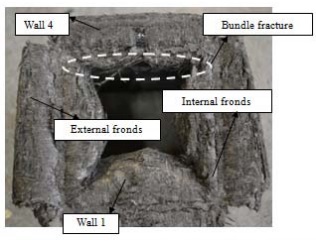
crush boxDespite extensive investigations on the energy absorbing capabilities of fibre reinforced polymer (FRP) composite absorbers under axial loading, the off-axis crashworthy behaviour of composite absorbers remains unknown. In the present paper, published by School Aerospace & Aircraft Engineering-Kingston University- London,   the effects of stitching on the crack growth resistance, energy absorption and also off-axis crashworthy behaviour of CFRP composite box sections will be studied. The analytical methods are implemented to investigate the effect of various failure modes such as bending, friction, bundle fracture, and interlaminar crack growth for the observed crushing modes.

Acceder article