Le sommaire et les résumés des articles du volume 26 de décembre 2012 de la revue Engineering Failure Analysis sont disponibles sur ScienceDirect.com.
Le sommaire et les résumés des articles du volume 26 de décembre 2012 de la revue Engineering Failure Analysis sont disponibles sur ScienceDirect.com.
Encore un article intéressant publié par Sciencedirect.com : Analyse de défaillance d’un joint en tube d’acier perforé par la corrosion dans une conduite de forage de puits.
Un cas de corrosion-érosion-cavitation sur des tubes de forage offshore. Les tubes en acier appartiennent à un pétrolier offshore ils sont utilisés pour le forage de puits de pipeline. L’analyse de défaillance a révélé que la défaillance de l’oléoduc a eu lieu par l’érosion, la corrosion cavitation, la corrosion érosion et chimiques, toutes ces actions à la fois mécaniques et chimiques se sont combinées pour provoquer la défaillance des tubes.

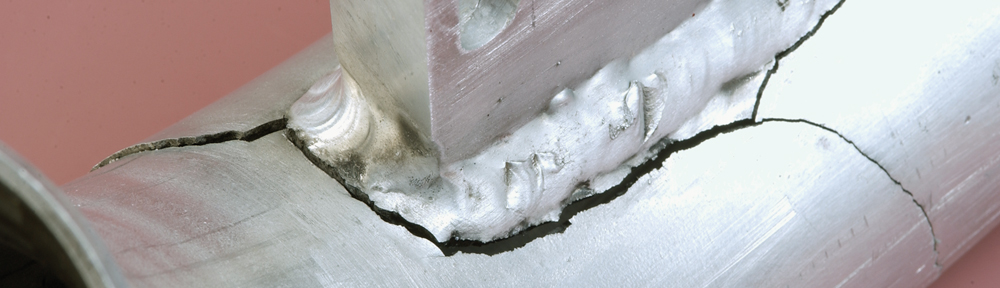
Macrograph of the leaked tube (a) The crack after penetration, (b) The cracks after polishing.
Après analyse de défaillance, il a été constaté que les tubes du surchauffeur, fabriqués en acier inoxydable Super304H, se sont fissurés en corrosion sous contrainte induite par de la corrosion intergranulaire. La cause externe de la corrosion intergranulaire a été la mise à nu des tubes dans l’environnement marin pendant quelques mois et la raison interne la très forte sensibilité à la corrosion intergranulaire des tubes.

This paper is a discussion about automotive suspension coil springs, their fundamental stress distribution, materials characteristic, manufacturing and common failures. An in depth discussion on the parameters influencing the quality of coil springs is also presented.
Following the trend of the auto industry to continuously achieve weight reduction, coil springs are not exempt. A consequence of the weight reduction effort is the need to employ spring materials with significantly larger stresses compared to similar designs decades ago. Utilizing a higher strength of steel possesses both advantages and disadvantages. The advantages include the freedom to design coil springs at higher levels of stress and more complex stresses. Disadvantages of employing materials with higher levels of stress come from the stresses themselves. A coil’s failure to perform its function properly can be more catastrophic than if the coil springs are used in lower stress. As the stress level is increased, material and manufacturing quality becomes more critical. Material cleanliness that was not a major issue decades ago now becomes significant. Decarburization that was not a major issue in the past now becomes essential.
To assure that a coil spring serves its design, failure analysis of broken coil springs is valuable both for the short and long term agenda of car manufacturer and parts suppliers. This paper discusses several case studies of suspension spring failures. The failures presented range from the very basic including insufficient load carrying capacity, raw material defects such as excessive inclusion levels, and manufacturing defects such as delayed quench cracking, to failures due to complex stress usage and chemically induced failure. FEA of stress distributions around typical failure initiation sites are also presented.
Voir la source : ScienceDirect – Engineering Failure Analysis : Design and failure modes of automotive suspension springs.
The failure reasons of the valve shell from automobile redirector were investigated by metallography, fractography and mechanical property test. The result showed that continuous Si-phase with dentritic shape due to the improper solution-aged process and excessive Fe element remained due to the ineffective modification treatment were the main reasons of components’ brittle fracture.
Plus d’info : http://www.scientific.net/AMR.415-417.2146
| a | University of Kragujevac, Faculty of Mechanical Engineering Kraljevo, Dositejeva 19, 36000 Kraljevo, Serbia |
| b | Laboratory for Testing of Materials High School Trstenik, Radoja Krstića 19, 37240 Trstenik, Serbia |
Drive in most bucket wheel excavators (BWE) is accomplished through its electric motor, cardan shaft and planetary gearbox. In the BWE SchRs630/6×25, the planetary gearbox is cantilevered at the end of the hollow shaft which transmits the torque through the sprocket to the caterpillar track chain. In this BWE, a the drive shaft fracture occurs at the point of support on the penetration side.
Experimental testing of the chemical composition and mechanical properties of the material of the shaft and metallographic inspections of the fracture surface by means of electronic and light microscopes carried out in the first part of the paper have shown that there are no significant inhomogeneities and errors in the material of the shaft and that they do not cause damage. Further, the analysis of results referring to the mechanical properties and chemical composition of the repaired shaft at the point of welding, and particularly in the transition zone, shows that they considerably deviate from those prescribed for the material used. Significant inhomogeneity of the material, occurrence of cracks as well as the difference in the microstructure appear in this zone, which is the cause of shaft damage.
The second part of the paper presents the FEM analysis of effects of the cantilever type of support of the planetary gearbox and stress concentration at the point of support due to inadequate finishing, which caused the occurrence of an initial crack. The user unsuccessfully tried to eliminate this weakness by repair welding of the shaft.
► The cause of the drive shaft fracture of the BWE SchRs630/6×25 was examined. ► The shaft fracture did not occur due to any errors in the material. ► The cause of the initial crack is inadequate machining of the shaft. ► The cause of the shaft fracture is the badly performed repair welding process.
Failure analysis of duplex stainless steel weld used in flexible pipes in off shore oil production.
Engineering Failure Analysis 17, p. 1500–1506. 6

Consumer Product Accidents – Shaft Failure

www.dtbtest.com/PDFs/steering-system-hydraulic-cylinder-failure.pdf

One of the six blades of an agricultural rotary cutter used for cutting down small trees and bushes broke into two pieces while the blades were rotating. One piece was hurled from the cutter and struck a young farmer, who had been operating the machine, causing a near fatal leg injury.
In the ensuing litigation against the manufacturers and marketer of the machine each litigant retained a metallurgist and other experts. The metallurgists jointly directed laboratory work on the broken blade conducted at an independent laboratory according to a protocol which they developed and which was approved by the court.
As a result of the laboratory work the present authors, working for the Plaintiffs, concluded that failure of the blade occurred because it contained quench cracks introduced when it was manufactured. The Defendants’ metallurgists concluded that the blade had been misassembled onto the machine and, as a result, had failed by fatigue. Eventually, the case was set for a jury trial in a Circuit Court in rural Kentucky. The jury found for the Plaintiffs and awarded them $5.9 million in damages. Part of this judgement was later reversed by the Kentucky Court of Appeals and the case was then settled without a second trial under terms which were not revealed.
Texte complet à télécharger : http://iopscience.iop.org/1742-6596/305/1/012130/pdf/1742-6596_305_1_012130.pdf


