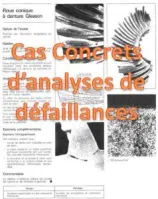
Quatre autres cas d’analyses de défaillances survenues en service : burin de perforateur, axe pivot de roue, ressort hélicoïdal, arbre de commande fraise. Ces quatre fiches d’analyse de défaillance avaient été publiées en 1983 et 1984 dans la revue Cetim-information. Des dizaines de milliers de cas ont été traités ces quarante dernières années par le Cetim. Cette expérience fait du Centre une référence dans le domaine à même d’intervenir dans tous les secteurs d’activités. Avec aujourd’hui ses centres associés et partenaires, l’Institut technologique Cetim met un ensemble de compétences et de moyens au service des industriels et experts pour analyser, comprendre et proposer des solutions permettant d’éviter la reproduction de ces défaillances. Les différentes expertises de cette série « Cas concrets » sont issues d’articles publiés dans la revue Cetim Informations dans les années 74 à 90. Bien que ces fiches traitant de cas concrets soient anciennes, leur contenu est toujours d’actualité…
Archives du mot-clef case study
Cas Concrets – Quatre défaillances par fissuration progressive
Quatre cas d’analyses de défaillances survenues en service : un vilebrequin de moteur marin, un arbre épaulé, un maillon de chaine d’élévateur et un taillant de forage. Ces quatre fiches d’analyse de défaillance avaient été publiées entre 1984 et 1985 dans la revue Cetim-information. Des dizaines de milliers de cas ont été traités ces quarante dernières années par le Cetim. Cette expérience fait du Centre une référence dans le domaine à même d’intervenir dans tous les secteurs d’activités. Avec aujourd’hui ses centres associés et partenaires, l’Institut technologique Cetim met un ensemble de compétences et de moyens au service des industriels et experts pour analyser, comprendre et proposer des solutions permettant d’éviter la reproduction de ces défaillances. Les différentes expertises de cette série « Cas concrets » sont issues d’articles publiés dans la revue Cetim Informations dans les années 74 à 90. Bien que ces fiches traitant de cas concrets soient anciennes, leur contenu est toujours d’actualité…
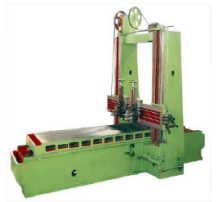
FAILURE ANALYSIS OF DRIVING MECHANISM IN HORIZONTAL PLANNING MACHINE
An article published in « International Journal of Research and Innovation in Engineering Technology » (IJRIET), available online 26 February 2016.
In this paper the failure analysis and optimization of horizontal mechanism in a horizontal planning machine rack and pinion arrangement is needed for the translation movement. In general, wear occurring in V-Guides ways and drive mechanism are not equal. So that, the variation of the wear amount should affect the surface level of to be machined component. The failure is rectified to implement the new mechanism (arrangement) in driven portion of the horizontal mechanism.
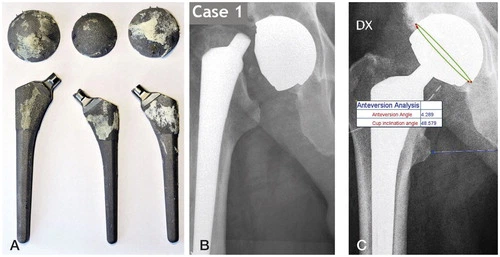
Primary hip replacement stem taper fracture due to corrosion in 3 patients – Acta Orthopaedica –
A interesting article published online: 11 Jan 2016, in « Acta Orthopaedica « .
Wear and corrosion of taper connections in modular hip prostheses have gained much attention due to the serious biological response that can occur due to the metallic debris originating from this articulation.They present 3 cases of stem taper fracture as the ultimate failure mode of this design.
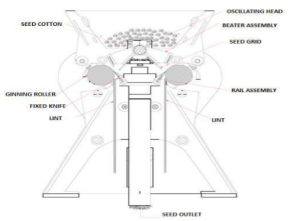
Needle Roller Bearing at Gudgeon Pin of Ginning Machine
A
paper published by IJRET (International Journal of Research in Engineering and Technology).
In ginning machine where space is limited for driving the mechanism a Needle roller bearing having diameter of 20 mm is used in between connecting rod and head pin to give the relative motion between parts. As the continuous impacting of repetitive load on bearing, it fails with in shorter period of time if proper lubricant is not supplied by grease gun after 2 to 3 hours. While bearing are considered under observation it is found that bearing are fail due to brinnelling. So design and analysis of needle roller bearing is vital to calculate the life of bearing and to make sure whether this bearing is suitable or not. So it becomes mandatory in designing to calculate radial load applied on bearing as the bearing is rolling contact bearing, from this life of the bearing can be calculated and finally analysis by ANSYS software is done to find the result so that we can conclude for bearing.
Read more at : IJRET20150411007.pdf
Case Study of severe Strip Breakage in Rolling Mill of TSCR
A new case study of Failure Analysis published in « Case Studies in Engineering Failure Analysis » of December 2015.
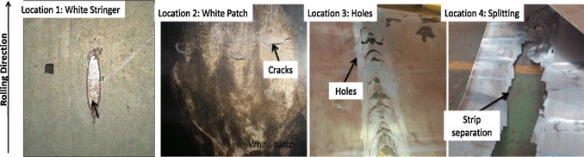
In this paper, a case of severe strip breakage in rolling mill of Thin Slab Casting and Rolling (TSCR) shop of TATA Steel, Jamshedpur is presented.Visual observation revealed complete splitting with material missing along the central axis of the strip. Presence of defects in form of white stringers, white patches and holes were observed along the same axis just ahead of split location. Metallurgical analysis revealed association of these defects with slag type foreign materials in the rolled strip. The entrapments of un-deformable materials like slag in slab resulted in the formation of surface discontinuities on the strip on account of differential rolling. The discontinuities manifested in form of holes at lower strip thickness in the later stands of the mill. Inhomogeneous deformation about such holes also resulted in material overlapping. In summary, the breakage of the strip was found to have a strong correlation with the presence of heavy chunk of foreign inclusions from secondary steelmaking sources.
Read more : Case Study of severe Strip Breakage in Rolling Mill
Failure Analysis of HDPE Pipe for Drinking Water Distribution and Transmission
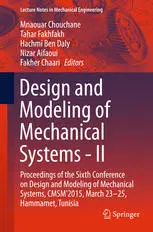
Un article paru dans la revue « Design and Modeling of Mechanical Systems » de mars 2015.
« Pipes and elbows are important components in any piping systems for transportation of water. These structures are subjected to complex loads taking into account their geometrical configuration and the multiplicity of the loading conditions in service. The origin of failure of these mechanical components is directly related to the presence of defects. The principal objective of this work is to analyze the severity of defects on high density poly-ethylene pipe widely used for water piping networks. »
Shape Fastener of the Bus Skeleton Testing
A paper presented at « International Conference on Electromechanical Control Technology and Transportation » (ICECTT 2015).
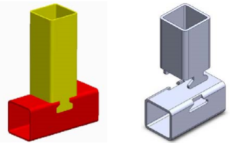
The paper deals with the bending tests of new designed joints for bus skeletons. The frames of buses have to satisfy various demands, but the safety of the passengers is the priority. The actual welded joints should be replaced by new type of profiles connections in the future. Finite elements method was used for the bending test simulation and for the stress investigation; the real experiments were done using the universal test equipment ZD10/90. Obtained results are comparable, so authors aim to realize next experiments in next days at which other shapes of the joints will be tested. Read more
Failure Analysis: Case Study Challenger SRB Field Joint
An article which will be published in International Journal of Engineering and Technology, Vol. 8, No. 6, December 2016.
The Challenger Solid Rocket Boosters (SRB) Field Joint initial design was deemed as a direct cause of the shuttles catastrophic failure during lift off. The Field Joint SRB was a key component in containing dangerous gases produced in the SRB. After conducting research on the Challenger accident, a Fault Tree Analysis was developed to analyze the reliability of the SRB field joint configuration in relation to its goals. The reliability model will show how the field joint fell short in terms of operational reliability. Read more at.
Analysis of a Clinically Failed
Un article paru en septembre 2015 dans la revue « Trauma Cases and Reviews » :
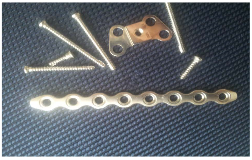
« A reconstructive orthopedic bone plate was submitted for analysis. Traditional failure analysis methods were used to assess the mode of the plate failure. Metallographic investigation of the plate was carried out in this report. Since limited data was available in the literature and clinical data related to subject demography, date of removal as well as reasons for removal unknown, in depth analysis was not possible. However, the plate was received in in-tact condition with minor biological deposits and scratches, it is speculated that the failure of the plate may have been due to biological/clinical reasons, likely infection, rejecting the device due to lack of union at the fracture site. » Lire l’article dans son intégralité …