
More informations : Failure analysis of a pinion of the jacking system of a jack-up platform.
More informations : Failure analysis of a pinion of the jacking system of a jack-up platform.
It is with great pleasure that I write the first editorial for Case Studies in Engineering Failure Analysis. (Richard Clegg)
We believe that the journal fills an important niche in the market. Other professions such as medicine and the law make great use of case studies, but engineers have not really formalised this to the same extent. It may be that our education tends to lead us to the view that all problems can be solved based on “First Principles” or through a program of rigorous scientific experimentation. But it has long been my belief that an enormous amount can be gained by studying how things behave in practice, and there is no better teacher than failure.
 An article published in the « Journal of Achivements in Materials and Manufacturing Engineering » . The objective of the work was to determine the influence of microstructure changes on JSHV300(SiNiCr2-3) cast iron tribological properties. Modification of the investigated cast iron microstructure was carried out by the heat treatment.
The paper presented by the « Academic Journal of Manufacturing Engineering » researches in the field of processing of composite materials manufactured by water jet cutting. In the last years, the field of composite materials reinforced by carbon fiber / epoxy matrix has developed increasingly more because of the advantages they offers. One of the challenges in this area is machining of the contour of complex parts. Therefore water jet cutting is proving to be a viable solution for this problem. But, also, to manufacture complex composite parts is required to optimize the water jet cutting process
Un nouvel article issu de ScienceDirect.com – Engineering Failure Analysis – Hot-water corrosion failure of a hard-drawn copper tube.
Le cuivre désoxydé au phosphore (C12200, DHP-Cu) est le matériau de prédilection pour les tuyauteries dans les systèmes de distribution d’eau et de CVC (chauffage, ventilation et climatisation) en raison de son excellente conductivité thermique et électrique, sa formabilité, sa résistance à la corrosion et qui possède aussi des propriétés antimicrobiennes. Cependant la conception et les défauts d’installation ou des paramètres environnementaux agressifs, tels qu’une qualité de l’eau inadéquate, peuvent conduire à des défaillances inattendues entraînant des pertes matérielles et de nombreuses fois les dommages matériels entrainent des coûts élevés de réparation. Dans le cas présenté, les résultats de l’analyse de défaillance suggèrent fortement que la fuite a été causée par une perforation à partir de l’intérieur du tube et qu’elle est due à de la corrosion par piqûres localisées due une chimie de l’eau impropre (teneur particulièrement élevée en chlore et un pH bas).
Un cas de corrosion sous tension rapporté par : ScienceDirect.com – Engineering Failure Analysis – Degradation of stainless steel grids in chemically aggressive environment.
L’ étude porte sur l’analyse de défaillance d’une grille en acier inoxydable austénitique perforée, opérant dans un échangeur de chaleur à calandre dans l’industrie pétrochimique. L’examen macroscopique de la grille révèle un état de surface friable et des fissurations orientées dans la direction perpendiculaire à la charge normal. Les deux faces de la grille ainsi que l’intérieur des trous de filtration sont couverts par des dépôts. L’examen microscopique indique des fissurations ramifiées, ce qui plaide en faveur de corrosion sous contrainte. En outre les microanalyses élémentaire menées dans les zones autour des vides indiquent la présence de fer et de chrome dans des proportions qui peuvent être corrélées à la formation de phaseσ. La détection d’oxygène, de fer et de chrome dans les fissures est attribuée à des produits de corrosion constitués d’un mélange d’oxydes de fer et de chrome. La défaillance prématurée de la grille inox serait survenue à cause d’une transformation structurale à haute température (précipitation de phase σ) ayant entraîné une sensibilisation à la corrosion sous contrainte. La substitution de l’acier inoxydable utilisé actuellement par un autre alliage de plus grande résistance à la corrosion sous contrainte et à structure plus stable à haute température est suggéré.
Acoustic emissions generated by a structure under stressed condition provide an insight in to the dynamic behaviour of flaws in the structure for characterization of failure modes. Fiber failure mechanism in T-700 carbon epoxy composites is characterized by testing unidirectional specimens in longitudinal mode. Acoustic emission parameters like amplitude, energy, duration, and signal strength have been recorded and studied with respect to the applied load to assess the fiber failure characteristics.
For more informations : http://www.ijesi.org/papers/Vol%202(4)/Version-6/D241926.pdf
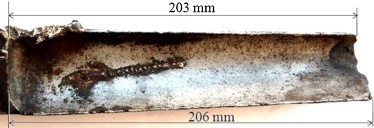
This paper deals with fracture investigations of low pressure (L P) steam turbine blade of a 110 MW thermal power plant in Punjab in India. These blades were made from chrome alloy steel X20Cr13 (Tempered martensitic stainless steel). The main focus of the paper is the fracture analysis, which took place at the airfoil region at 203 mm from the root of the blade. One of the fractured blades was retrieved to identify the cause of failure. The investigations included the visual examination, SEM fractography, chemical analysis, hardness measurement, and micro-structural characterization. While preparing the test specimen, silicon rich phases were detected on the blade along with oxide scale present inside the corrosion pits and fractured region. Transgranular cleavage fractures along with beach marks are observed. The cause of failure is possibly the corrosion-fatigue. These causes of failure are also underlined in this paper.
 A new publication of the International Journal of Electrochemical Science, May 1, 2013 …
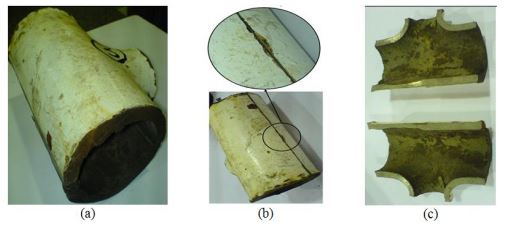
An extensive investigation into the erosion–corrosion behavior and failure analysis of an offshore steel tubular joint has been carried out by various electrochemical techniques, visual inspection, optical microscope examination, mechanical testing, microstructure examination, chemical analyses, Scanning Electron Microscope (SEM) examination, Finite Element Analysis (FEA) and Computational Fluid Dynamics (CFD).
 Click here to visit the Top 25 Engineering Failure Analysis’s hottest articles (January to March 2013)


