Corrosion in a carbon steel refinery hydrocarbon line

A interesting paper in « Case study in Engineering Failure Analysis » published on ScienceDirect.com.

An explosion and fire occurred at a refinery site leading to the evacuation of the site and to millions of pounds worth of damage to the facility. A laboratory investigation was carried out to establish the immediate cause and any underlying factors that may have contributed to the incident. This paper brings out the detail of investigation carried out.

touche Read more


FAILURE ANALYSIS – CASE STUDIES II

Capture Case studies IIEn ligne, un ouvrage de 460 pages regroupant des études de cas concrets  de défaillances  sélectionnés à partir des pages de  « Engineering Failure Analysis » 1997- 1999, édité by D.R.H. JONES, Department of Engineering – University of Cambridge, UK.

telecharger le doc

Failure Analysis – Industrial Case Studies

This web site deals with industrially-derived case studies in forensic engineering and failure analysis, which are firmly grounded in the context of their legal, insurance and design consequences. The development of this interactive learning package follows on from existing web-based projects in learning support via on-line tutorials, focussed internet resources and detailed analysis and discussion of case studies in failure.

More at : Failure Analysis – Industrial Case Studies.

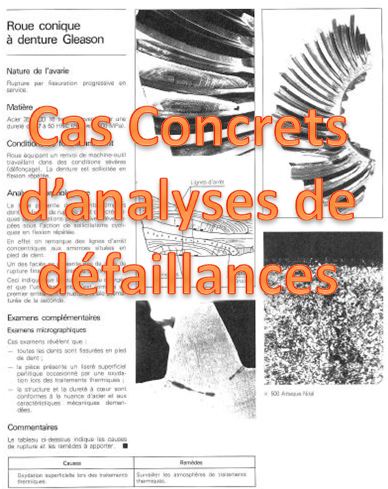
Cas Concrets – Des ruptures par fissuration progressive en fatigue

Avatar Cas ConcretsQuatre nouveaux cas d’analyses de défaillances survenues en service : burin de perforateur, axe pivot de roue, ressort hélicoïdal, arbre de commande fraise, à consulter dans la Mécatech du Cetim.

telecharger le doc

Failure analysis of a bridge crane shaft

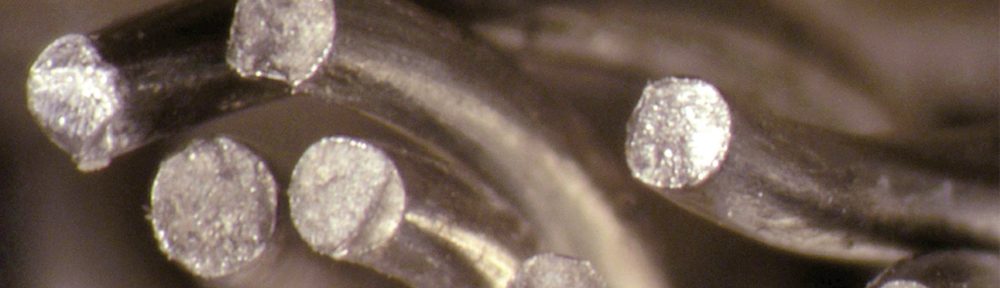
Failure analysis of a shaft used in a bridge crane has been carried out. The shaft was fractured in the keyway with evidence of fatigue.

This paper published in  » Engineering Failure Analysis » was finded on ScienceDirect.com.

Read the article : click here

Ruptures d’arbres épaulés clavetés (2)

Avatar Cas ConcretsUn précédent article « Vintage », publié par le Cetim dans la Mécatech, faisait état d’une règle pratique de positionnement des rainures de clavetage sur les arbres épaulés. Quatre fiches «Cas Concrets» illustraient cette publication. Voici cinq autres fiches «Cas Concrets» d’analyse de défaillance d’arbres épaulés clavetés rompus en fatigue qui viennent compléter cet article.

telecharger le doc

Failure of a Motor Vessel’s Crankshaft 1968

An interesting paper published in  « Engineering Failure Analysis » :

In July 1968 the Swedish motor vessel “MV Stureholm” traveled from Sweden across the North Atlantic with destination to the American gulf harbours.  About 100 nautical miles north of the peninsula Yucatan the 9,000 HP diesel engine failed as a consequence of fatigue failure of the crankshaft. The ship was disabled and had to be towed to Veracruz, Mexico. The Swedish shipowning company decided to perform a temporary repair in Veracruz by welding the fatigue crack. Back in Sweden the damaged but repaired crankshaft was dismounted from the engine and inspected by surveyors. The result was that a fatigue crack had initiated from a subsurface solidification (hot) crack.

This paper brings out the detail of investigation carried out. Read more at : Failure of a Motor Vessel’s Crankshaft 1968.
Premature cracking of dies for aluminum alloy die casting

Die casting AluminiumAn interesting paper of Bogdan Pawlowski, AGH University of Science and Technologie in Krakow, published in « Archives of Metallurgy and Materials » :

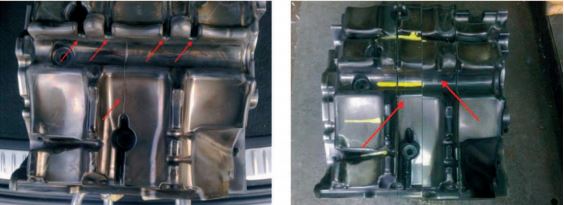
Two identical dies for aluminum alloy die-casting failed prematurely because of a number of parallel cracks on the working surface. These cracks were of a mechanical nature related to incorrect microstructural banding orientation of the die core and related to improper heat treatment. The root cause of premature cracking of dies was improper heat treatment (temper embrittlement).

More at :  http://imim.pl/files/archiwum/Vol4_2013/40.pdf

Rupture d’un tuyau d’égout sous pression en PVC

Le document décrit l’analyse de défaillance d’un tuyau d’égout en polychlorure de vinyle non plastifié (PVC-U) de diamètre nominal 200 mm, classe de pression 12, qui s’est rompu prématurément après 34 ans de service. L’étude devait permettre de savoir si la défaillance était due à un défaut de fabrication ou bien à une dégradation des propriétés du PVC sous l’effet de l’environnement agressif.

Lire l’article.