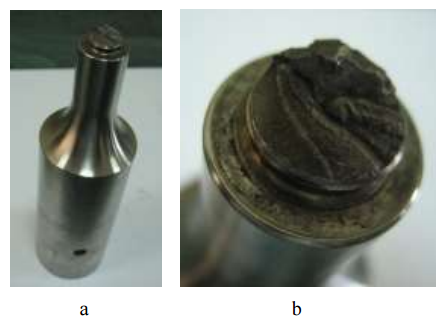
Failure analysis of a Ti-6Al-4V ultrasonic horn used in cavitation erosion tests

MekanicaA paper published in MECHANIKA. 2015 Volume 21(4): 272–276.

During the testing of the materials’ cavitation erosion resistance on vibratory systems by direct method (ASTM G32), the thread from the ultrasonic horn – test specimen connection, is subjected to fatigue. Operational experience has shown the occurrence of cracks and fractures in this area after a number of stress cycles that was lower than anticipated. The paper presents an analysis applied on four types of ultrasonic horns geometries: the original geometry with an external thread M12 and three modified geometries, with an internal thread M10 and M8. The four geometries were subjected to static analysis in order to determine the stress distribution. Based on static analysis, the behavior of the horns to fatigue was simulated and analyzed, determining the fatigue life, safety factors and optimal geometry.
Read more

Failure analysis of edge discoloration of galvanized fuel tank

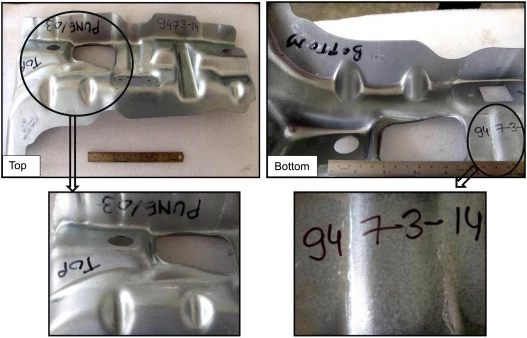
An interesting case study of failure analysis of defect on the surface of some galvanized fuel tank will be published on October 2015 in Case Studies in Engineering Failure Analysis 

A peculiar type of edge discoloration defect on the surface of some galvanized fuel tank was observed, causing significant appearance problems. In the study, the surface defect was characterized by visual inspection, optical microscopy, scanning electron microscopy and energy dispersive spectroscopic analysis to understand the source and mechanism of the defect. The paper presents the results of the investigation.

Read more

Failure analysis of a motor-car coil spring

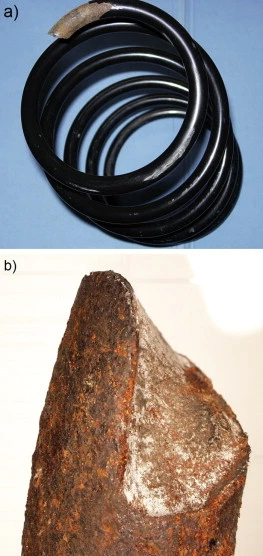
An interesting case study of failure analysis of a motor-car coil spring broken was published in Case Studies in Engineering Failure Analysis on December 2013. A damage of protective layer was the reason for corrosion occurrence. A combination of corrosion and fatigue caused the failure of the spring.

Read more

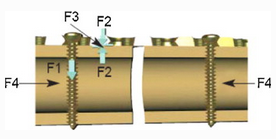
A failure analysis study on the fractured connecting bolts of a filter press

An interesting case study of failure analysis will be published in Case Studies in Engineering Failure Analysis in October 2015

The purpose of this study was to investigate the main causes of the co-fracture of sixteen connecting bolts of a filter press cylinder–piston system. Stress state of the bolts during the service conditions has been analyzed and the failure reasons were determined from the fractography analysis and gathered information. According to the obtained results, it was concluded that the bolts had failed by the fatigue mechanism. It seems that insufficient torque was used during assembly.

Read more at : A failure analysis study on the fractured connecting bolts of a filter press

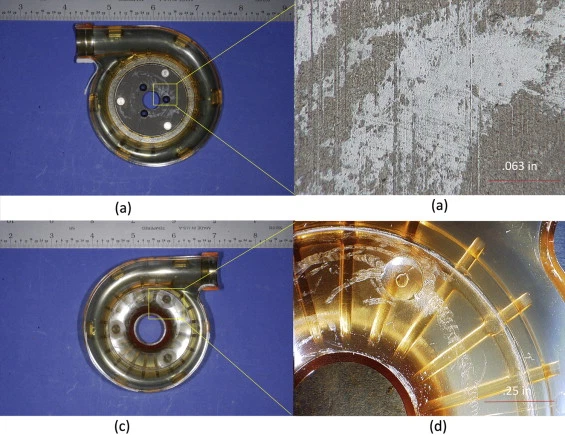
Failure Analysis of a Polymer Centrifugal Impeller

An other new case study of failure analysis had been published in october 2015 in Case Studies in Engineering Failure Analysis.

A failure analysis investigation was performed on a fractured polymer impeller used in a respiratory blower. A radial split down the impeller center was observed, with symmetric fracture faces about the impeller bore. The brittle fracture morphology and defects within the impeller bore suggest that premature failure occurred because of multiple interacting factors including: intermittently high centrifugal velocities, imbalance bore and shaft conditions, defects within the bore caused by machining, and stress concentrations along the circumference of the impeller lip.

Read more at : Failure Analysis of a Polymer Centrifugal Impeller.

Leg Weld Fatigue Cracks in Anhydrous Ammonia Nurse Tanks

A new case study of failure analysis was published on  Case Studies in Engineering Failure Analysis, april 2015

In an accident in southwest Iowa, USA in 2012, an anhydrous ammonia nurse tank vented its entire cargo of 5500 liters (1500 gallons) of liquid ammonia to the atmosphere. Follow-up study of the failed tank revealed a through-crack along a weld used to connect the tank to its running gear. The authors recommend that side-angle ultrasound be considered for use in periodic nurse tank inspections.

via Leg Weld Fatigue Cracks in Anhydrous Ammonia Nurse Tanks.

Coeur Carmat : on en sait plus sur les premiers hommes implantés

Les informations concernant les premiers malades ayant reçu un cœur artificiel Carmat étaient jusqu’à présent distillées au compte-gouttes. Grâce à la publication mercredi 29/07/2015 dans The Lancet d’un article émanant du Pr Alain Carpentier – le chirurgien cardiaque concepteur de ce cœur artificiel – et de ses collègues de l’hôpital européen Georges-Pompidou à Paris ainsi que du CHU de Nantes, on en sait un peu plus sur les deux premiers malades. « L’analyse des deux dispositifs n’a révélé aucune défaillance mécanique et les sources d’éléments électroniques défectueux ont été trouvées et corrigées dans les procédures de fabrication ultérieures », peut-on lire.

Lire l’article du Point du 30/07/2015.

A failure Study of a locking compression plate implant

2015-05-03_11h57_31


An interesting  paper in « Case study in Engineering Failure Analysis » published on ScienceDirect.com. In this case study a failed locking compression plate was investigated. Such plating systems are used to provide the stability to fractured bone and fixation. The locking compression plate had been separated in two pieces. One of the fracture surfaces from the failed component was investigated for surface topographical features. The visual, optical and scanning electron microscopy results indicated the presence of beach marks, intermetallic inclusions, corrosion pits and striations indicating fatigue crack propagation and overload failure. Some corrosion damage also was documented on the fractography. This case study shows that corrosion may have initiated fatigue crack which grew by the activities of daily living causing the failure.

To read the article click here

Failure Analysis of a Polymer Centrifugal Impeller

A new case study published in Case Studies in Engineering Failure Analysis and posted on Sciencedirect.com.

The failure analysis investigation was performed on a fractured polymer impeller used in a respiratory blower. The brittle fracture morphology and defects within the impeller bore suggest that premature failure occurred because of multiple interacting factors including: intermittently high centrifugal velocities, imbalance bore and shaft conditions, defects within the bore caused by machining, and stress concentrations along the circumference of the impeller lip.

more at : Failure Analysis of a Polymer Centrifugal Impeller.

Failure analysis of the mobile elevating work platform


An interesting  paper in « Case study in Engineering Failure Analysis » published on ScienceDirect.com. This paper outlines investigations of the accident which occurred during startup of the extending structure from the transport position of a mobile elevating work platforms. The investigation results presented in this paper are important because same or similar problems could arise in supporting structures of various types of transportation, construction and mining machines.

More at : click here