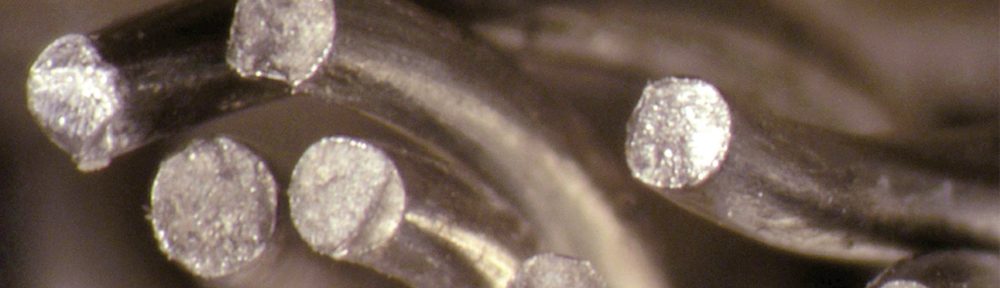

During a modification programme, the Wing Attachment Fitting (WAF) cadmium-plated steel bolt assemblies from 33 F-16 aircraft were cleaned in a non-approved chemical solution, a paint stripper. This removed much of the cadmium plating, leading to in-service superficial rusting of some bolt ends and nuts. The OEM and chemical manufacturer became concerned about possible hydrogen embrittlement of the bolts owing to exposure to the paint stripper. This paper brings out the detail of investigation carried out.
 Alertée par un de ses clients pour un problème de décollement de peinture sur des touches de commande de siège automobile,
  The proliferation of advanced IC package configurations is driving the need for new tool failure analysis (FA) tool development. Although scientists and engineers in the semiconductor industry developed new tools and techniques based on Moore’s Law, with its need to analyze ever-smaller devices, the advent of three-dimensional packaging schemes requires new tools.
  Kiln of a lime plant, a part of an integrated steel plant, converts limestone (CaCO3) into lime (CaO) by heating at a temperature of around 900 °C using coke oven gas as a fuel. Coke oven gas is a by-product of the coke plant, which contains mainly hydro-carbons. The coke oven gas is lanced into the kiln through a number of pipes attached to the kiln. The lance pipes are cracking prematurely within 6 months of their service against an expected service life of 3 years. The analysis of cracking of the lance pipe is presented in this article. It will be published in
  Discoloration and delamination (D&D) of encapsulant in a photovoltaic (PV) module affect the electrical characteristics. Therefore,
  La mécanique de la rupture a été introduite par
  Read on
 The Leak-Before-Break (LBB) concept has an effect on the safety design of Fast Breeder Reactors (FBRs), and thus its assessment has been one of the most significant issues. In the case of a commercial-scale FBR, since the main loads are the thermal expansion and thermal transient stresses, ferrite steel with a low thermal expansion rate has been a candidate material. A conventional LBB assessment method is insufficient to consider these characteristics, thus an advanced method is required.
 The main aim of this study was to analyze the pitting corrosion and stress corrosion cracking which is initiated on prototype cold-formed outer exhaust sleeves during the testing of different cleaning procedures before chromium plating. Various microscopic methods were used to identify the initiation of corrosion and its propagation.
 The erosion rate of convection surfaces is crucial for boiler reliability.