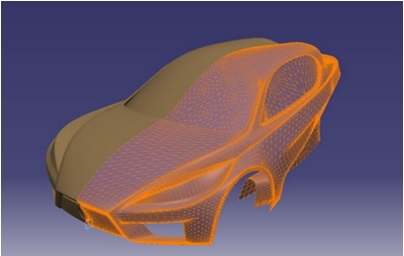
The main goals of this project were the development of the body for an electric vehicle and the study of the front fender. Various aspects related with the project of a fiberglass component were addressed in this work like the choice of materials, and manufacturing processes of composite materials. In order to test the front fender, this was modeled seperatly and imported to ANSYS classic. A model with solid elements and a tailored mesh was developed, having one element per ply in the through the thickness direction and accounting for aspects like contact and laminate layup. Failure analysis was made by a progressive damage model with a set of Hashin type failure criteria.

Archives de l’auteur : geraldb17
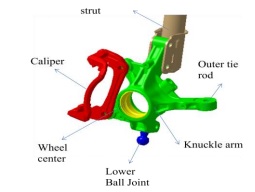
Durability Analysis of the Knuckle Arm for a Small Size Car
A paper published in « PCO Proceeding 2013 based on AIP Guide« .
Abstract. Traditionally, the durability performance of vehicle components and subsystem has been investigated and verified by testing physical prototypes. In this study, we performed durability analysis of the knuckle arm. In this study, the stiffness and durability of the knuckle installed in a small size car are investigated using commercial software. Parametric analytical studies have been carried out to estimate the stiffness and fatigue life using commercial software.
Engineering Failure Analysis, le Top 25 de 2013
Les 25 articles les plus lus de janvier à décembre 2013, la majorité d’entre eux ont fait l’objet de post sur « Les Experts Défaillances »
Failure analysis of deaerator/sourgas stripper cylinder of ammonia
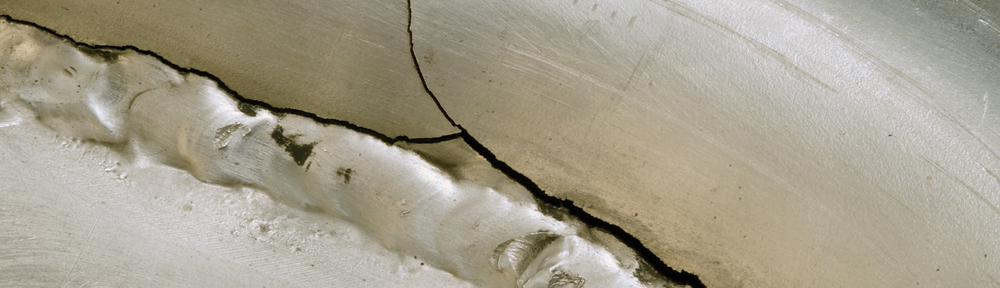
A new « Case Studies in Engineering Failure Analysis » online 17 June 2014, about the cracking leakage accident of deaerator/sourgas stripper cylinder in a chemical fertilizer plant. The analysis results indicated that improper welding was the main reason for the cylinder cracking failure. Chromic carbide (Cr23C6) was precipitated at partial grain boundaries of the transition region between base metal and weld seam and induced the depletion of Cr element at the grain boundary and in the vicinity of grain boundary. Cl− in the media was enriched at the grain boundary of chromium depletion region and formed pitting corrosion, which could lead to stress-corrosion cracking of cylinder under tensile stress.
Analysis and Performance of Automobile Engine Components Considering Thermal and Structural Effects
An article published in « International Journal of Innovative Research in Science, Engineering and Technology« , January 2014.
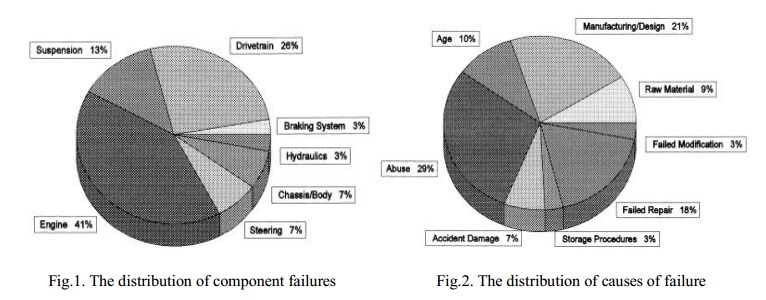
This paper presents an investigation report of effect of various parameters which affect the performance of an automobile engine. Almost all internal combustion engines have at least one connecting rod to transmit the thrust of the piston to the crankshaft, and as the result the reciprocating motion of the piston is translated into rotational motion of the crankshaft. From the viewpoint of functionality, connecting rods must have the highest possible rigidity at the lowest weight capable to withstand varying loads. It has been found that structural failure of various components results in engine missing and starts producing noise and vibration during racing, mileage gets affected and black or white smoke arise also pickup gets reduced. In automobile industry damaged or broken parts are generally too expensive to replace or repair especially in case of engine. In this concern they presented detailed analysis of causes along with preventive maintenance suggestion schedule for better engine life.
Des garnitures soumises aux exigences de l’EPR
Afin d’obtenir d’EDF et d’Areva la qualification de ses garnitures mécaniques d’étanchéité destinées aux pompes des réacteurs nucléaires de troisième génération (EPR), John Crane France a testé ses garnitures mécaniques d’étanchéité sur un banc d’essai de manière à répondre aux nouvelles exigences des centrales nucléaires de troisième génération (EPR). Ce banc sert dorénavant à toute la profession. Mis au service de l’ensemble de la profession, les bancs d’essais du Cetim sont rapidement transformés et suivent l’évolution des besoins. La compétence des équipes permet de réaliser dans les délais des essais à hautes performances.
Lire l’article dans le document ci-joint. ![]()
Delamination-Debond Behaviour of Composite T- Joints in Wind Turbine Blades
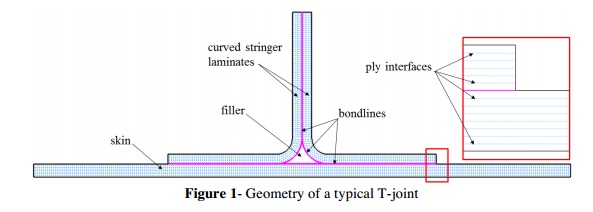
A pubication in « Journal of Physics »: Conference Series, 2014. Wind turbine industry utilizes composite materials in turbine blade structural designs because of their high strength/stiffness to weight ratio. T-joint is one of the design configurations of composite wind turbine blades. T-joints are prone to delaminations between skin/stiffener plies and debonds between skin-stiffener-filler interfaces. In this study, delamination/debond behavior of a co-bonded composite T-joint is investigated under 0° pull load condition by 2D finite element method. The failure sequence consists of debonding of filler/stringer interface during one load drop followed by a second drop in which the 2nd filler/stringer debonds, filler/skin debonding and skin delamination leading to total loss of load carrying capacity. This type of failure initiation has been observed widely in the literature. Failure initiation and propagation behavior, initial and max failure loads and stress fields are affected by the property change. In all cases mixed-mode crack tip loading is observed in the failure initiation and propagation stages. In this paper, the detailed delamination/debonding history in T-joints is predicted with cohesive elements for the first time.
Reduction in diversion due to coil break
A new case study, in « Case Studies, in Engeeniring Failure Analysis », Volume 2, Issue 2, October 2014, Pages 76–83.

Diversion due to coil break in cold rolled non oriented (CRNO) grades of coils showed an increasing trend during Jan–May’12 at Silicon Steel Mill (SSM), Rourkela Steel Plant (RSP). Coil break increased from a level of less than 1% during to a level of 30% in May’12. Further studies were carried out in the processing lines and material flow was tracked from steel making to final product. The probable reasons were identified and corrective measures were taken leading to reduction in diversion due to coil break less than 2%.
Crack of a first stage blade in a steam turbine
A new Case Study in « Case Studies in Engineering Failure Analysis », Volume 2, Issue 2, October 2014, Pages 54–60

The failure of the first stage blade in a steam turbine of 55 MW was investigated. The blade was made of 17-4 PH stainless steel and has been used for 12 years before failure. The current work aims to find out the main cause of the first stage blade failure. The result showed that the crack at the blade root tang was due to corrosion fatigue and the crack occurred at the blade root fillet owing to stress corrosion cracking.
A detailed review and Prediction of Ductile Fracture
A publication in « IJRAME« , april 2014.
Earlier researchers were studied the failure analysis through various Failure Mode and Effective Analysis (FMEA) technique and tried to predict the fracture before failure occurs. This work attempts to predict the ductile fracture criterion for the sheet metal to avoid the failure by means of considering various controllable and uncontrollable parameters. With the Design of Experiments and the Artificial Neural Network techniques a ductile fracture initiation criteria modeled and the model will be validated through Finite element simulation for the verification of the quality. If comparison results are within the limit condition, the model can be utilized for the prediction of ductile fracture before it happens in the real application.