Failure Analysis of HDPE Pipe for Drinking Water Distribution and Transmission

Un article paru dans la revue « Design and Modeling of Mechanical Systems » de mars 2015.

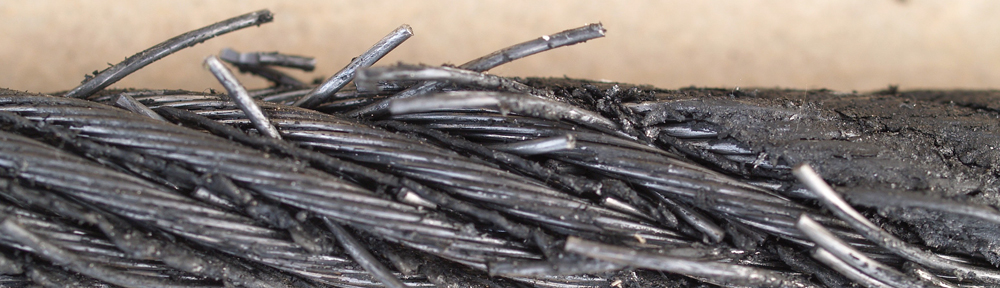
« Pipes and elbows are important components in any piping systems for transportation of water. These structures are subjected to complex loads taking into account their geometrical configuration and the multiplicity of the loading conditions in service. The origin of failure of these mechanical components is directly related to the presence of defects. The principal objective of this work is to analyze the severity of defects on high density poly-ethylene pipe widely used for water piping networks. »

Voir l’article


Shape Fastener of the Bus Skeleton Testing

fasternerA paper presented at « International Conference on Electromechanical Control Technology and Transportation » (ICECTT 2015).

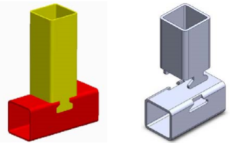
The paper deals with the bending tests of new designed joints for bus skeletons. The frames of buses have to satisfy various demands, but the safety of the passengers is the priority. The actual welded joints should be replaced by new type of profiles connections in the future. Finite elements method was used for the bending test simulation and for the stress investigation; the real experiments were done using the universal test equipment ZD10/90. Obtained results are comparable, so authors aim to realize next experiments in next days at which other shapes of the joints will be tested. Read more

Testing methodologies for corrosion fatigue on offshore constructions

offshoreA Ghent University Academic Bibliography publication.

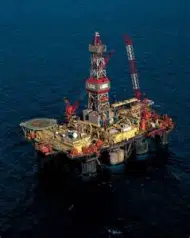
Offshore constructions are subjected to cyclic loading conditions. This situation is combined with the corrosive nature of the surrounding environment. This literature review first introduces the reader to corrosion fatigue. Thereafter a critical comparison of some typical lab-scale fatigue corrosion test setups is given. Special emphasis is devoted to the instrumentation of the setup. This is followed by a design criteria summary which will be used to design a new corrosion fatigue test set-up for evaluating the fatigue properties of steel components in sea water environnent. Read more

Analysis of a Clinically Failed

2015-11-17_08h30_32Un article paru en septembre 2015 dans la revue « Trauma Cases and Reviews » :

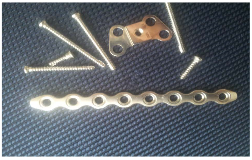
« A reconstructive orthopedic bone plate was submitted for analysis. Traditional failure analysis methods were used to assess the mode of the plate failure. Metallographic investigation of the plate was carried out in this report. Since limited data was available in the literature and clinical data related to subject demography, date of removal as well as reasons for removal unknown, in depth analysis was not possible. However, the plate was received in in-tact condition with minor biological deposits and scratches, it is speculated that the failure of the plate may have been due to biological/clinical reasons, likely infection, rejecting the device due to lack of union at the fracture site. » Lire l’article dans son intégralité …


Effect of Ply Orientation on Strength and Failure Mode of Pin Jointed Unidirectional Glass-epoxy Nanoclay Laminates

An article published in « Defence Science Journal2015-11-15_11h18_30« , November 2015. In this work the effect of the different ply orientations and nano filler on the bearing strength and failure mode of the pin joints is investigated both experimentally and numerically.  Results show that the strength of the pin joints is drastically dependent on both ply orientations and nanofiller wt%. The joint geometry i.e., the distance from the free edge of specimen to the diameter of the hole (E/D) ratio and width of the specimen to the diameter of the holes (W/D) ratio were also investigated which effected the failure mode of the joints. Tsai-Wu failure theory along with the characteristics curve method was used for the prediction of failure modes numerically. Read more ….

Failure analysis of a leaked oil pipeline

2015-10-18_11h39_48A new paper in « Case Studies in Engineering Failure Analysis« .

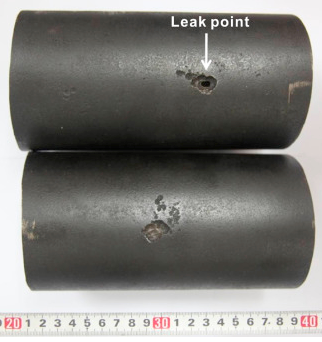
An oil pipeline embedded in an underground trench had failed. Through the accident investigation they found that there was a perforation at the leak point of the pipeline. After careful analysis it is concluded that the leakage of the pipeline was mainly caused by the liquid impingement erosion.

Click here to read more

Journal of the Indian Institute of Science A Multidisciplinary Reviews Journal

A publication of the « Journal of the Indian Institute of Science » about nanocomposites.

Fiber reinforced polymer (FRP) composites are widely used in structural applications, mainly due to their high specific strength and stiffness. These composites experience several types of static and fatigue loads in service. For a safe and durable structure, high fracture toughness and enhanced fatigue life are prominent requirements of these composite materials. Efforts have been made in recent times to improve the fracture toughness and fatigue properties of FRP composites by incorporation of second phase fillers in the epoxy matrix. Addition of nano sized fillers to the epoxy has led to the development of a new class of materials— polymer nanocomposites. The presence of nano fillers has been shown to improve the fracture toughness and fatigue life of bulk epoxies as well as FRPs with nano-modified epoxy matrix. The type of nano filler, its shape, size, volume fraction and dispersion in the epoxy have all been shown to influence these properties significantly. In this review, an overview on the effect of nano fillers on the fracture toughness and fatigue life of bulk epoxies and FRPs is presented. The mechanisms proposed for observed improvements in these properties and the empirical method of prediction of fatigue life of nanocomposites subjected to spectrum fatigue loads simulating service loads are also discussed.

Read more


Failure analysis of a motor-car coil spring

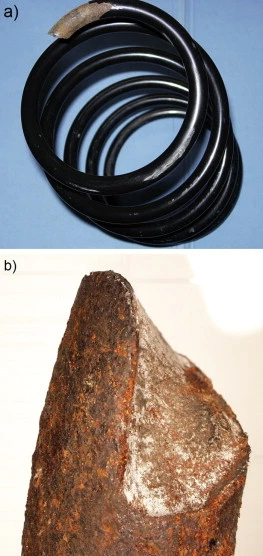
An interesting case study of failure analysis of a motor-car coil spring broken was published in Case Studies in Engineering Failure Analysis on December 2013. A damage of protective layer was the reason for corrosion occurrence. A combination of corrosion and fatigue caused the failure of the spring.

Read more

A failure analysis study on the fractured connecting bolts of a filter press

An interesting case study of failure analysis will be published in Case Studies in Engineering Failure Analysis in October 2015

The purpose of this study was to investigate the main causes of the co-fracture of sixteen connecting bolts of a filter press cylinder–piston system. Stress state of the bolts during the service conditions has been analyzed and the failure reasons were determined from the fractography analysis and gathered information. According to the obtained results, it was concluded that the bolts had failed by the fatigue mechanism. It seems that insufficient torque was used during assembly.

Read more at : A failure analysis study on the fractured connecting bolts of a filter press

Leg Weld Fatigue Cracks in Anhydrous Ammonia Nurse Tanks

A new case study of failure analysis was published on  Case Studies in Engineering Failure Analysis, april 2015

In an accident in southwest Iowa, USA in 2012, an anhydrous ammonia nurse tank vented its entire cargo of 5500 liters (1500 gallons) of liquid ammonia to the atmosphere. Follow-up study of the failed tank revealed a through-crack along a weld used to connect the tank to its running gear. The authors recommend that side-angle ultrasound be considered for use in periodic nurse tank inspections.

via Leg Weld Fatigue Cracks in Anhydrous Ammonia Nurse Tanks.