Failure analysis of a leaked oil pipeline

2015-10-18_11h39_48A new paper in « Case Studies in Engineering Failure Analysis« .

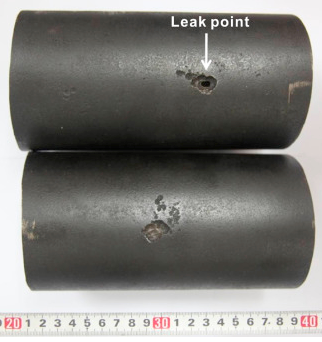
An oil pipeline embedded in an underground trench had failed. Through the accident investigation they found that there was a perforation at the leak point of the pipeline. After careful analysis it is concluded that the leakage of the pipeline was mainly caused by the liquid impingement erosion.

Click here to read more

Journal of the Indian Institute of Science A Multidisciplinary Reviews Journal

A publication of the « Journal of the Indian Institute of Science » about nanocomposites.

Fiber reinforced polymer (FRP) composites are widely used in structural applications, mainly due to their high specific strength and stiffness. These composites experience several types of static and fatigue loads in service. For a safe and durable structure, high fracture toughness and enhanced fatigue life are prominent requirements of these composite materials. Efforts have been made in recent times to improve the fracture toughness and fatigue properties of FRP composites by incorporation of second phase fillers in the epoxy matrix. Addition of nano sized fillers to the epoxy has led to the development of a new class of materials— polymer nanocomposites. The presence of nano fillers has been shown to improve the fracture toughness and fatigue life of bulk epoxies as well as FRPs with nano-modified epoxy matrix. The type of nano filler, its shape, size, volume fraction and dispersion in the epoxy have all been shown to influence these properties significantly. In this review, an overview on the effect of nano fillers on the fracture toughness and fatigue life of bulk epoxies and FRPs is presented. The mechanisms proposed for observed improvements in these properties and the empirical method of prediction of fatigue life of nanocomposites subjected to spectrum fatigue loads simulating service loads are also discussed.

Read more


Computational Investigation of Superalloy Persistent Slip Bands Formation

An interesting paper published in Proceedings of the 21st International Conference on Automation & Computing, University of Strathclyde, Glasgow, UK, 11-12 September 2015.

Persistent slip bands (PSB) is the important and typical microstructure generated during fatigue crack initiation. Intensive works have been done to investigate the mechanisms of the formation of persistent slip bands in the past decade. In this paper, a molecular dynamics (MD) simulation associated with embedded atom model (EAM) is applied on the PSBs formation in nickel-base superalloys with different microstructure and temperature under tensiletensile loadings. Simulation results show that PSBs formed within the 𝛄  phase by massive dislocations pile-up and propagation which can penetrate the grain. Also, the temperature will affect the material fatigue performance and blur PSBs appearance. The simulation results are in strong agreement with the experimental test results published before.

Read more

Flywheel starter ring gear failures and hardness variation reduction in surface hardening process

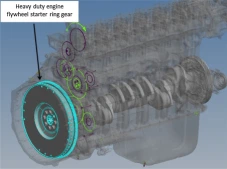
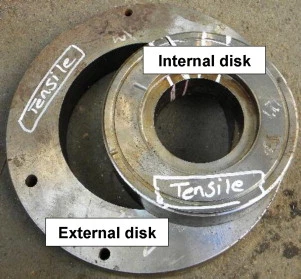
A new case study published in Case Studies in Engineering Failure Analysis. This technical paper summarizes the case study conducted for truck flywheel starter ring gears with diameter of 470 mm in order to reduce hardness variation by optimization of induction hardening and tempering processes.

Read more

Nouveau robot portatif pour l’évaluation des contraintes résiduelles des pièces métalliques

Le Cetim présent sur Enova 2015 a présenté pour la première fois le X-Raybot, un robot portatif dédié à l’évaluation des contraintes résiduelles des pièces métalliques par diffraction de rayons X, codéveloppés avec la société MRX.

Lire l’article paru dans « Contrôles-Essais-Mesures »

Failure analysis of a Ti-6Al-4V ultrasonic horn used in cavitation erosion tests

MekanicaA paper published in MECHANIKA. 2015 Volume 21(4): 272–276.

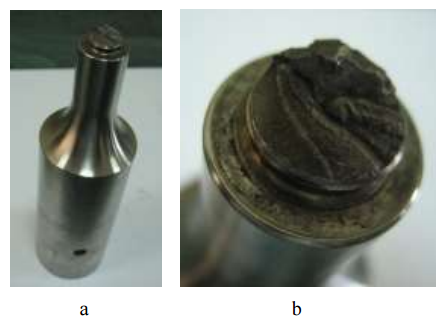
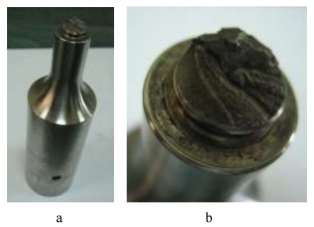
During the testing of the materials’ cavitation erosion resistance on vibratory systems by direct method (ASTM G32), the thread from the ultrasonic horn – test specimen connection, is subjected to fatigue. Operational experience has shown the occurrence of cracks and fractures in this area after a number of stress cycles that was lower than anticipated. The paper presents an analysis applied on four types of ultrasonic horns geometries: the original geometry with an external thread M12 and three modified geometries, with an internal thread M10 and M8. The four geometries were subjected to static analysis in order to determine the stress distribution. Based on static analysis, the behavior of the horns to fatigue was simulated and analyzed, determining the fatigue life, safety factors and optimal geometry.

Read more

Failure analysis of edge discoloration of galvanized fuel tank

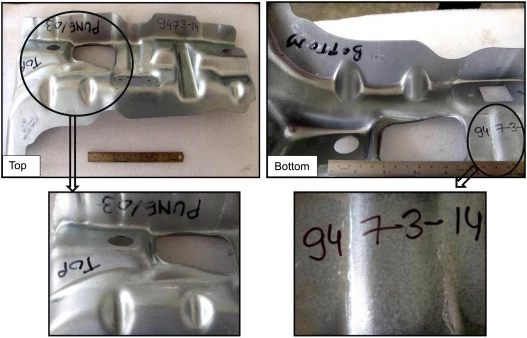
An interesting case study of failure analysis of defect on the surface of some galvanized fuel tank will be published on October 2015 in Case Studies in Engineering Failure Analysis 

A peculiar type of edge discoloration defect on the surface of some galvanized fuel tank was observed, causing significant appearance problems. In the study, the surface defect was characterized by visual inspection, optical microscopy, scanning electron microscopy and energy dispersive spectroscopic analysis to understand the source and mechanism of the defect. The paper presents the results of the investigation.

Read more

Anticiper les risques de blocage des galets

Gimar Montaz Mautino a mis au point SecuRM, un nouveau système de sécurité qui contrôle en permanence la vitesse de rotation des galets qui supportent les câbles. Pour s’assurer que le système résisterait aux conditions climatiques extremes  en montagne, il fallait le testé en enceinte climatique. C’est la raison pour laquelle elle a contacté le Cetim.


Lire la suite

A failure analysis study on the packing cups of a hyper compressor

An interesting case study of failure analysis of two packing cups failed by fatigue failure was published in Case Studies in Engineering Failure Analysis of June 2015

The packing cups of the second stage cylinders of the polyethylene hyper compressors failed after service life of about three months.

Read more

Failure analysis of a motor-car coil spring

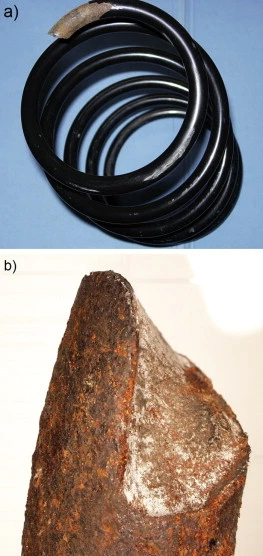
An interesting case study of failure analysis of a motor-car coil spring broken was published in Case Studies in Engineering Failure Analysis on December 2013. A damage of protective layer was the reason for corrosion occurrence. A combination of corrosion and fatigue caused the failure of the spring.

Read more